

To calibrate a humidor hygrometer, seal it in a bag with damp table salt for 8 to 12 hours. Saturated salt holds the air at 75% RH, so a correctly calibrated hygrometer reads 75%. Anything else is your offset — correct it with the adjustment screw, or write it down and apply it to every future reading.
A humidor hygrometer is the only instrument standing between your cigars and slow, invisible damage. The problem is that almost every hygrometer sold today ships uncalibrated, and the cheap analog dials packed into humidor lids are frequently wrong by 10 percentage points or more straight out of the box. Learning how to calibrate a humidor hygrometer is therefore not an optional refinement — it is the step that decides whether every reading you take afterwards means anything at all.
This guide walks through the salt test in full, explains what the widely quoted “75%” figure actually refers to, and shows how to handle hygrometers that have no adjustment screw. The reference values come from the National Institute of Standards and Technology, not from cigar forum folklore.
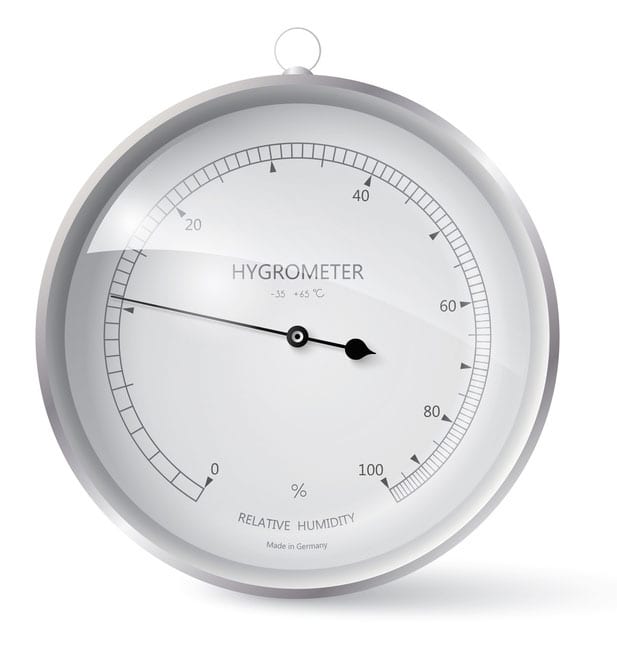
What Does It Mean to Calibrate a Humidor Hygrometer?
Calibrating a humidor hygrometer means placing it in an environment of precisely known relative humidity, comparing what it displays against that known value, and then correcting the difference — either by adjusting the instrument or by recording a fixed offset you apply to every future reading.
Calibration does not make a sensor better. It tells you how wrong it is. That distinction matters, because a hygrometer that reads 8 points low but reads 8 points low consistently is genuinely useful once you know about the error. A hygrometer whose error you have never measured is just a number generator with a nice bezel.
The reference environment used almost universally for this is a sealed container holding a saturated salt slurry. If you want the broader theory behind how these instruments respond to moisture in the first place, our explainer on how hygrometers work covers the underlying mechanisms.
Why Every Humidor Hygrometer Drifts Over Time
Humidity sensors are not stable instruments. They age. Even good industrial-grade capacitive sensors carry a published long-term drift specification — humidity instrumentation manufacturer Process Sensing Technologies quotes under 1% RH per year for their probes in clean air, and recommends replacing a sensor once its drift exceeds 3% RH, because deterioration accelerates from that point.
That is the figure for a professional probe in clean conditions. A ten-dollar hygrometer sitting in a sealed box full of aromatic tobacco oils, glycerol from humidification beads, and cedar volatiles is not operating in clean air. Drift in that environment is faster and less predictable.
There is a second, less-discussed issue. A manufacturer’s headline accuracy figure — the “±2% RH” printed on the box — is usually measured at a single temperature, typically around 23 °C, and does not include hysteresis, linearity error, long-term stability, or the uncertainty of the calibration standard itself. Total real-world uncertainty is always worse than the number on the packaging. Calibrating your own humidor hygrometer is how you find out by how much.
The Salt Test: What 75% RH Actually Means
When a saturated solution of table salt (sodium chloride) sits in a sealed container, the air above it stabilises at a specific, repeatable relative humidity. This is a physical property of the salt, which is why it works as a calibration reference without any equipment.
Most guides round this to “75%” and stop. The real value is temperature-dependent, and the definitive measurements come from Lewis Greenspan’s 1977 study for the National Bureau of Standards (now NIST), which compiled 1,106 individual measurements across 21 separate investigations:
| Temperature | Equilibrium RH over saturated NaCl | Uncertainty |
|---|---|---|
| 20 °C (68 °F) | 75.47% | ± 0.14 |
| 25 °C (77 °F) | 75.29% | ± 0.12 |
| 30 °C (86 °F) | 75.09% | ± 0.11 |
The practical takeaway: across any room temperature you would realistically keep a humidor at, the salt reference sits between roughly 75.1% and 75.5% RH. Using 75% as your target introduces an error of less than half a percentage point — far smaller than the error in the hygrometer you are testing. So 75% is a perfectly good working number. But it is worth knowing why it is a good number rather than treating it as a magic constant.
What You Need for the Salt Test
- The humidor hygrometer you want to calibrate
- Ordinary table salt — around two tablespoons. Iodised is fine; sea salt offers no advantage
- A small bottle cap, shot glass, or similar shallow container
- A few drops of water
- A resealable zip-top bag, or a rigid airtight container large enough to hold both items without them touching
- 8 to 12 uninterrupted hours in a room with stable temperature
That is the entire equipment list. No purchase is required, which is the main argument for the salt test over commercial kits.
How to Calibrate a Humidor Hygrometer in 7 Steps
Work through these in order. The two steps people most often rush — the water ratio and the stabilisation time — are the two that most often ruin the result.
Step 1: Make the salt slurry
Fill your bottle cap or shot glass about halfway with salt. Add water a few drops at a time and stir until the salt is uniformly damp but not submerged. The target texture is wet sand: the salt should clump and hold its shape, with no standing pool of water on top.
This ratio is the single most common failure point. Too much water and you have a dilute salt solution rather than a saturated one, and a dilute solution equilibrates at a higher humidity than 75%. Undissolved salt crystals must remain visible — that is the visual confirmation that the solution is genuinely saturated.
Step 2: Seal both items in the bag
Place the slurry container and the humidor hygrometer inside the bag. Position them so they are not touching, and so no salt or water can splash onto the sensor. Press out most of the air and seal the bag completely. Air-tightness matters more than air volume — a leaking bag will simply equilibrate with your room.
Step 3: Leave it somewhere temperature-stable
Put the sealed bag somewhere out of direct sunlight, away from radiators, air conditioning vents, and exterior walls. Temperature stability is what you are protecting here. A swinging temperature drags the relative humidity inside the bag around with it and the sensor never settles.
Step 4: Wait 8 to 12 hours
The air inside the bag needs time to reach equilibrium with the salt, and the sensor then needs time to respond to that air. Analog hygrometers, which rely on a mechanical element physically absorbing moisture and changing dimension, are slower than digital ones and benefit from the full 12 hours. Do not open the bag to peek — you reset the clock.
Step 5: Read it through the bag
Read the display without opening the bag. This is important: a humidor hygrometer removed from a 75% RH environment into a 45% RH room begins responding within seconds, and a digital sensor can drop several points before you have found your reading glasses.
Step 6: Calculate the offset
Subtract the reference value from the reading. Using 75% as the reference:
- Displays 75% → the hygrometer is accurate. No correction needed.
- Displays 68% → it reads 7 points low. Correction: add 7 to every future reading.
- Displays 81% → it reads 6 points high. Correction: subtract 6 from every future reading.
An error of more than about 10 points on a digital hygrometer usually indicates a failing sensor rather than a calibration problem, and the unit is better replaced than corrected.
Step 7: Adjust or record
What you do with the offset depends on the instrument, which is covered in the next section.
Adjustable vs Non-Adjustable Humidor Hygrometers
Not every humidor hygrometer can be physically corrected, and the fix differs.
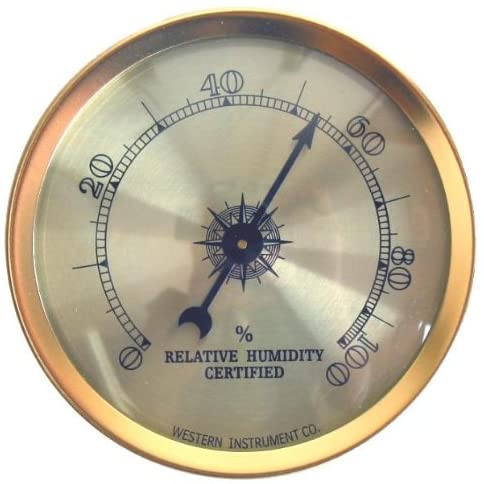
Analog hygrometers with a calibration screw. Most round analog units have a small recessed screw or slotted dial on the back. With the unit still holding its salt-test reading — work quickly, or do it inside the bag if the opening allows — turn the screw until the needle points to 75%. Recheck by running the test a second time to confirm the adjustment held.
Digital hygrometers with a calibration function. Some mid-range and premium digital models have a dedicated calibration mode, usually accessed by holding a button while inside the test environment. Consult the manual; the sequence varies by manufacturer and there is no standard.
Non-adjustable units. The majority of inexpensive digital hygrometers cannot be adjusted at all. This does not make them useless. Write the offset on a small label and stick it to the back of the unit — “reads 6 low, add 6”. A consistently offset hygrometer with a known correction is more trustworthy than an unadjusted one you have never tested. The one thing that matters is that the offset stays stable, which is why re-testing periodically is still necessary.
Using a Pre-Made 75% RH Calibration Kit
Commercial calibration kits contain a salt solution sealed in a permeable sachet that holds a fixed 75% RH. You drop the sachet and the hygrometer into the supplied bag and wait, typically 24 hours rather than 12.
The advantage is consistency: there is no slurry to mix incorrectly, which removes the most common source of user error. The disadvantages are cost and shelf life — the sachets expire and need replacing. For someone calibrating one or two hygrometers once or twice a year, the salt test costs nothing and works just as well. For someone maintaining several humidors, a kit is a reasonable convenience purchase. Our general guide to how to calibrate a hygrometer covers kit-based calibration for non-humidor applications in more detail.
A widely available example is the Boveda One-Step Calibration Kit (75% RH), which supplies the sachet and the bag in one pack.
Boveda One-Step Calibration Kit on Amazon →
Two-Point Calibration with Magnesium Chloride
A single-point salt test tells you how the instrument behaves at 75% RH. It tells you nothing about its behaviour at 33% or 90%. Sensors are not necessarily linear across their range, and a unit that is accurate at 75% can still be several points out at the bottom of the scale.
For a second reference point, saturated magnesium chloride equilibrates at 32.78% RH ± 0.16 at 25 °C, according to the same Greenspan dataset. Running both tests reveals whether your error is a constant offset across the range or a slope error that changes with humidity.
For humidor use specifically, this is usually unnecessary. Cigars are stored in a narrow band around 65–70% RH, and the sodium chloride reference at 75% sits close enough to that working range for a single-point test to be genuinely representative. Two-point calibration is worth the effort if you use the same hygrometer for a humidor and for something at the other end of the scale, such as monitoring a dry storage area or a general household space.
Five Mistakes That Ruin a Salt Test
- Too much water. A visible pool of liquid means the solution is no longer saturated, and the test will read high. Damp sand, not soup.
- Not enough time. Four hours is not enough, particularly for analog units. Give it a full overnight cycle.
- Opening the bag to read it. The reading starts changing immediately. Read through the plastic.
- Temperature swings. A windowsill in direct sun is the worst possible location. An interior cupboard is ideal.
- Calibrating multiple hygrometers in one bag. This is fine in a large rigid container with adequate air volume, but crowding several units into one small zip bag can slow equilibration considerably.
How Often Should You Recalibrate?
Every six months is a sensible default for a humidor hygrometer in regular use. Recalibrate immediately if any of the following apply:
- The unit has been dropped or exposed to condensation
- You have replaced the battery on a digital model
- Readings have shifted noticeably with no change to your humidification routine
- Two hygrometers in the same humidor disagree by more than a few points
- The instrument is new — including expensive ones, and including units advertised as pre-calibrated
That last point deserves emphasis. “Factory calibrated” describes the state of the instrument when it left the factory, which may have been eighteen months and several thousand shipping miles ago.
What Should Your Humidor Hygrometer Read?
Once your hygrometer is trustworthy, the target it should show becomes a meaningful question.
The traditional advice is the “70/70 rule” — 70% RH at 70 °F. It remains a reasonable starting point, but many experienced smokers now consider 70% slightly high for burn quality, and target somewhere in the 65–69% RH band instead. The practical boundaries are clearer than the ideal: below roughly 62% RH wrappers become brittle and prone to cracking, and above roughly 74% RH cigars turn spongy, draw poorly, and enter genuine mould risk territory.
Temperature is the constraint people forget. The cigarette beetle (Lasioderma serricorne), the pest responsible for the small bore holes that ruin a collection, is strongly temperature-driven. According to Purdue University Extension’s stored product pest guide, its larvae become inactive between 60–66 °F and dormant below 60 °F, while its eggs hatch in 5–6 days at 95 °F versus up to 22 days at 68 °F. The same source gives its optimum relative humidity as 70–80% — which overlaps uncomfortably with a humidor run at the high end of the traditional range.
Keeping storage cool is therefore doing more work than keeping it precisely humidified. A humidor at 68 °F and 68% RH is in considerably better shape than one at 78 °F and a perfect 70%. This is a strong argument for using a combined thermohygrometer rather than a humidity-only gauge, so temperature is never the variable you are not watching.
Can I calibrate a humidor hygrometer without salt?
Not reliably. The wet-cloth or damp towel method that circulates online produces an environment close to 100% RH in principle, but in practice it is difficult to reach and hold, and most consumer hygrometers are least accurate at the extreme top of their range. Salt is cheap and the method is well characterised. There is no good reason to substitute.
How long does salt test calibration last?
The calibration itself does not expire, the sensor drifts away from it. Six months is a reasonable re-test interval for typical humidor conditions, sooner if the readings start behaving oddly.
Why does my new hygrometer need calibrating?
Because factory calibration is a snapshot, not a permanent state. Sensors drift during storage and shipping, and low-cost units are often calibrated loosely to begin with. Testing a new humidor hygrometer before trusting it takes one overnight cycle and frequently reveals a several-point error.
My two hygrometers disagree. Which one is right?
Possibly neither. Two hygrometers disagreeing tells you at least one is wrong, it does not tell you which. Salt-test both. It is common to find both are off, in different directions.
Does the salt test work on analog humidor hygrometers?
Yes, and analog units generally need it more than digital ones. The spring-and-metal mechanism in a typical lid-mounted analog gauge is inherently less precise than an electronic sensor, and it is also the type most likely to have an adjustment screw. Our overview of hygrometer types and their uses explains the mechanical differences in more depth.
Should I calibrate at 75% if I store cigars at 65%?
Yes. 75% is close enough to the 65-70% working range that the result is representative, and it is the reference point with the best-characterised value and the most accessible materials.
The Bottom Line
A humidor hygrometer you have never calibrated is not a measurement — it is a guess with a decimal point. The salt test costs nothing, takes one overnight cycle, and converts an unknown instrument into a known one. Whether you correct the error with a screwdriver or simply write it on a label, the outcome is the same: the number on the display finally means something.
If you are still choosing an instrument, or replacing one that failed its test badly, our guide to the best hygrometer for a humidor covers which specifications actually matter and which are marketing. For calibration in non-humidor contexts, see calibrating your hygrometer.
References
- Greenspan, L. (1977). Humidity Fixed Points of Binary Saturated Aqueous Solutions. Journal of Research of the National Bureau of Standards — A. Physics and Chemistry, 81A(1).
- Purdue University Extension. Stored Product Pests (E-239).
- Process Sensing Technologies. Humidity Measurement Accuracy.
