

Digital hygrometers are more accurate and respond faster; analog hygrometers need no battery and can look better on a shelf. For most people measuring humidity in a home, office, or humidor, that trade-off resolves in favor of digital — but the honest answer depends on what you’re measuring, how often you check it, and whether you’re willing to calibrate what you buy.
This guide breaks down the actual technology behind each type, where the real accuracy differences come from, and which one makes sense for your situation. Neither type is inherently a scam or a gimmick — they’re solving the same problem with different trade-offs.
The Short Answer
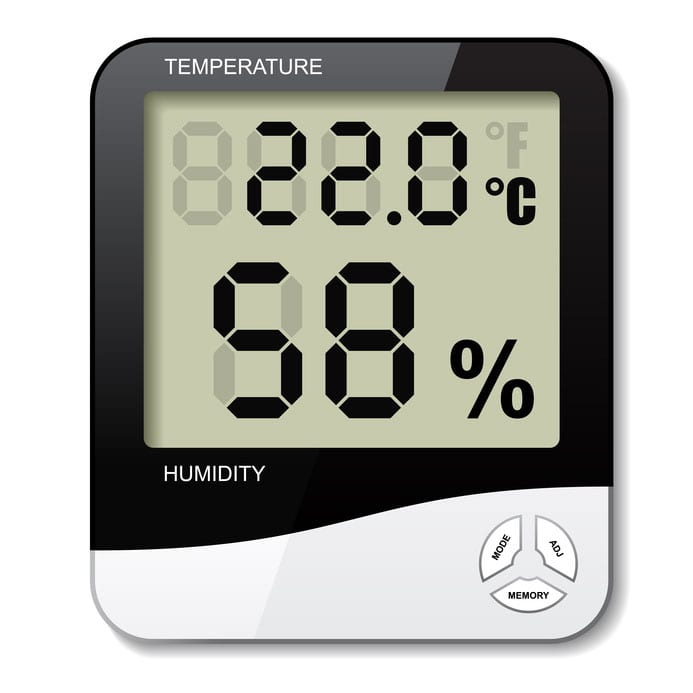
Digital hygrometers use an electronic sensor and a display; analog hygrometers use a mechanical or chemical element connected to a needle. Digital wins on accuracy, response time, and readability. Analog wins on cost, battery independence, and — for some people — appearance. If you only remember one thing: a digital hygrometer that’s never been calibrated and an analog hygrometer that’s never been calibrated are both guessing. Calibration matters more than the technology underneath it.
How Each Type Actually Works
Analog: Mechanical and Hygroscopic
Analog hygrometers rely on a material that physically changes shape as it absorbs or releases moisture — traditionally human hair, though modern units more often use a coiled synthetic fiber or a thin metal-and-paper spring. As humidity rises, the material expands or contracts, and a mechanical linkage translates that movement into a needle position on a dial.
This is the same operating principle behind the analog gauges built into most cigar humidors, and it explains why they’re the unit most likely to need calibration straight out of the box — the mechanism is inherently less precise than an electronic sensor, and manufacturing tolerances on cheap coiled-spring mechanisms are loose.
Digital: Capacitive and Resistive Sensors
Digital hygrometers almost always use one of two electronic sensor types. A capacitive sensor consists of two metal electrodes separated by a thin polymer film; as the film absorbs moisture, its electrical capacitance changes in a predictable way, and the sensor’s electronics convert that into a humidity reading. A resistive sensor uses a similar hygroscopic material, but measures the change in electrical resistance rather than capacitance.
According to sensor manufacturer Servoflo’s technical comparison, capacitive sensors are generally considered more accurate and stable with more repeatable results, while resistive sensors tend to be more price-competitive. This is why capacitive sensors dominate the mid-range and premium consumer hygrometer market — the cost gap has narrowed as capacitive sensors have moved to semiconductor manufacturing, while the accuracy gap has stayed roughly the same.
Digital vs Analog: Side-by-Side Comparison
| Factor | Analog (mechanical) | Digital (capacitive/resistive) |
|---|---|---|
| Typical uncalibrated error | Often 5–15 points | Often 2–7 points |
| Response time | Slow — can take hours to fully settle | Fast — typically minutes |
| Calibration | Usually a rear adjustment screw | Model-dependent; some cannot be adjusted at all |
| Displays temperature | Rarely | Usually, alongside humidity |
| Power source | None required | Battery |
| Typical cost | Lower for basic units | Slightly higher, though the gap has narrowed |
| Readability | Needle and dial — no backlight | Digital display, often backlit |
| Longevity of accuracy | Mechanism wears and drifts with age | Sensor drifts more slowly if kept clean |
Where Digital Genuinely Wins
Speed and precision are the real differentiators. If you’re diagnosing a problem — a humidor that won’t hold humidity, a basement with a suspected leak, a greenhouse with inconsistent ventilation — a digital hygrometer shows you the change as it happens. A slow-responding analog gauge smooths short-term fluctuations into invisibility, which is fine for a stable, well-managed space and unhelpful for troubleshooting one that isn’t.
Digital units also almost always report temperature alongside humidity, which matters because relative humidity is meaningless without a temperature reference — the same amount of water vapor in the air produces a different RH reading at different temperatures. A combined reading is simply more useful data for the same glance at the device.
Where Analog Still Makes Sense
Battery independence is the one advantage digital can’t match. An analog hygrometer in a rarely-checked space — a wine cellar you visit monthly, a closed storage room — won’t fail silently because a battery died months ago. There’s also a genuine aesthetic case: a brass-and-glass analog gauge suits a traditional humidor or a display case in a way a plastic digital unit doesn’t, and for cigar storage specifically, many collectors run both — an analog gauge for the visual check and a digital thermohygrometer for the number they actually trust.
Cost is a smaller factor than it used to be. Basic analog units are still cheaper than premium digital ones, but a decent calibratable digital hygrometer is now available at a similar price point to a mid-range analog gauge — the “digital costs more” assumption is weaker than it was a decade ago.
Accuracy Claims: What the Numbers Don’t Tell You
A manufacturer’s accuracy specification — “±2% RH” printed on the box — is usually measured under laboratory conditions at a single reference temperature. It typically doesn’t account for hysteresis, long-term drift, or the accuracy of the calibration standard used to establish the figure in the first place. This is true for both technologies, though analog mechanisms are generally more susceptible to mechanical wear over time than electronic sensors are to component drift.
The practical takeaway is the same regardless of which type you buy: treat the printed accuracy figure as an optimistic starting point, not a guarantee, and salt-test whatever you buy before trusting it.
Which Should You Buy?
- Choose digital if you want the most accurate reading available, need temperature alongside humidity, are monitoring somewhere you check often, or want to diagnose problems quickly.
- Choose analog if the space is rarely checked and you want to avoid battery failure, if you specifically want the traditional look for a humidor or display case, or if you’re on a tight budget for a basic monitor.
- Consider both if you’re managing something valuable — cigars, instruments, wine — where a second, independent reading is worth the small extra cost.
Whichever you choose, the single biggest factor in whether it tells you the truth isn’t digital versus analog — it’s whether you’ve calibrated it. An uncalibrated digital hygrometer and an uncalibrated analog one are both just guessing with different amounts of confidence.
Are digital hygrometers always more accurate than analog?
Generally yes, when both are calibrated, but an uncalibrated digital hygrometer can easily be less accurate than a calibrated analog one. Calibration matters more than the underlying technology.
Do analog hygrometers need batteries?
No. Analog hygrometers work through a mechanical or hygroscopic element and a needle, with no power source required. This is their main practical advantage over digital models.
Can I calibrate a digital hygrometer the same way as an analog one?
The salt test itself is identical for both. The difference is what you do with the result: many analog units have a rear screw for physical adjustment, while some digital units have no adjustment at all and require you to record and apply a fixed offset instead.
Which type is better for a cigar humidor?
Digital is generally the better default for accuracy and response time, but many experienced collectors keep an analog gauge for a quick visual check alongside a calibrated digital thermohygrometer for the number they actually rely on.
Why do two hygrometers in the same room show different readings?
Almost always because at least one is uncalibrated, or because they are positioned in slightly different microclimates within the room — near a window, vent, or exterior wall, for example. Salt-test both before assuming either is correct.
For more on the full range of measurement technologies, see our overview of hygrometer types and their uses, and if you’re outfitting a cigar collection specifically, our guide to the best hygrometer for a humidor covers the specifications that matter most in that context. For acoustic instruments, where the case is the environment being measured, see our guitar hygrometer guide.
Reference
- Servoflo Corporation. Humidity Sensors: Capacitive vs. Resistive.

6 thoughts on “Digital vs Analog Hygrometer: Which Should You Buy?”