
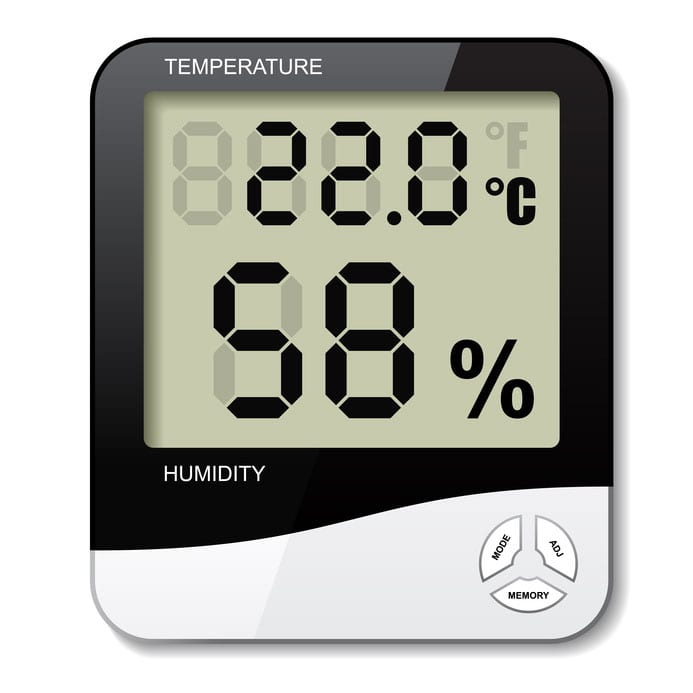

A hygrometer is used to measure the relative humidity of the air around it. People reach for one wherever humidity has to stay inside a narrow band — a cigar humidor at 65–72% RH, a reptile terrarium, a greenhouse, a wine cellar, or a damp room where mould is a risk.
What Is a Hygrometer Used For?
The underlying job is always the same: tell you how much water vapour is in the air, so you can act on it. What changes is why that number matters.
In a living space it is about comfort and health. When air is moist, perspiration evaporates more slowly and a room feels hotter than the thermometer suggests; when air is dry, skin moisture evaporates quickly and the same temperature feels cooler. Getting humidity right often means you can run heating or cooling less hard for the same comfort.
Everywhere else it is about protecting something. Sustained high humidity peels paint, encourages mould, spoils food faster and aggravates allergies. Sustained low humidity cracks wood, warps instruments and dries out anything organic. The sections below cover the situations where people most often buy a hygrometer, and what reading to aim for in each; for room-by-room targets indoors, see our home hygrometer guide.
Humidors: Keeping Cigars at 65–72% RH
Cigar storage is probably the single most common reason people buy a dedicated hygrometer. Tobacco leaf expands and contracts with the moisture around it: too dry and wrappers turn brittle and crack, too damp and cigars draw poorly and enter genuine mould territory.
The practical band is roughly 62–74% RH, with most people targeting somewhere around 65–69%. The catch is that the analog gauge built into most humidor lids is frequently wrong by ten points or more out of the box, which makes calibration more important than the purchase decision. Our guide to the best hygrometer for a humidor covers which specifications actually matter, and the humidor calibration walkthrough covers the salt test step by step.
Greenhouses: Propagation and Disease Control
Greenhouse growers use hygrometers for a reason that surprises people coming from houseplant care: the target is much higher. Most common greenhouse crops grow best at around 80% RH during the day, well above the 30–50% you would want indoors.
The risk sits at the top of that range rather than the bottom. Once readings hold above roughly 85–90% RH, condensation forms on leaf surfaces and fungal diseases such as Botrytis and powdery mildew take hold. A greenhouse hygrometer is really an early-warning device for disease pressure, which is why response time matters more here than in a static room. See our greenhouse humidity guide for targets by growth stage.
Reptile Terrariums: Species-Specific Humidity
Terrarium keeping is the use case with the widest spread of correct answers. Desert species such as bearded dragons and leopard geckos want 20–40% RH; rainforest species and amphibians want 70–90%. Getting it wrong causes real health problems — chronically low humidity leads to incomplete sheds and retained eye caps, while chronically high humidity in a desert setup promotes bacterial and fungal growth.
Because most enclosures run a deliberate gradient from a warm end to a cool end, humidity varies across the tank too, and a single probe placed near a heat source will read low for the enclosure as a whole. Our reptile terrarium humidity guide lists targets by species group.
Wine Cellars: Why Humidity Protects Corks
Wine storage is the use case where humidity arguably matters more than temperature. A cork is not perfectly airtight by design — wine ages through slow gas exchange — but that only works while the cork stays hydrated and elastic. Below about 50% RH corks dry out and shrink, oxygen gets in faster than intended, and the wine ages prematurely.
The working range is roughly 50–70% RH, with around 60% widely treated as the target. Above about 70–75% the problem flips: mould on corks and labels, and adhesive degradation that costs you resale value. Full detail is in our wine cellar humidity guide.
Damp Rooms, Basements and Mould Risk
Basements, bathrooms and utility rooms are the diagnostic use case: you are not maintaining a target so much as confirming a suspicion. Mould and dust mites become a problem when humidity sits above roughly 60% RH for extended periods, so a basement hygrometer is really a monitor for whether ventilation or a dehumidifier is keeping up.
A min/max memory function earns its keep here, because the damaging readings usually happen overnight or while you are out, and a spot check at the wrong moment will miss them entirely.
Musical Instruments and Storage
Acoustic instruments are built from thin, unfinished wood that moves with moisture. Guitars, pianos and violins are generally kept between 40% and 50% RH; below that, tops and fingerboards can crack, and above it wood swells and glue joints soften. The same logic applies to storing books, photographs and documents.
Industrial, Medical and Scientific Use
At the precise end of the scale, hygrometers govern manufacturing processes, surface coating, food production, incubators, clean rooms and server rooms. In a surgical or intensive-care setting, accuracy carries clinical consequences, so instruments are specified far more tightly than anything sold for household use.
This is where the gap between a ten-euro household meter and a laboratory instrument becomes real. An inexpensive device varying by up to 10 percentage points is of no consequence in a living room and completely unacceptable in a process environment.
Which Type of Hygrometer Suits Which Use?
The right instrument follows from the application. A mechanical hair-tension dial is adequate for a rough household reading and needs no battery. A capacitive digital sensor is the sensible default for humidors, terrariums and greenhouses, where you want accuracy and a fast response — our ranked best hygrometer for home guide covers the digital units we recommend. A psychrometer or chilled-mirror instrument belongs in reference and laboratory work.
For a full breakdown of the mechanisms behind each option, see our guide to the 11 types of hygrometer and how each one works. Whichever you choose, calibrate it before you trust it — an uncalibrated hygrometer is a guess with a display.
Frequently Asked Questions
What is a hygrometer used for?
A hygrometer is used to measure the relative humidity of the air. People use one wherever humidity has to stay inside a narrow band — cigar humidors, greenhouses, reptile terrariums, wine cellars, damp basements, and rooms holding wooden instruments or stored paper.
What is a hygrometer used for in the home?
Mostly comfort and damage prevention. Keeping a living space between roughly 30% and 50% RH limits mould and dust mites at the top end and prevents dry skin, static and cracked wood at the bottom. In basements and bathrooms it works as an early warning that ventilation is not keeping up.
Do I need a hygrometer for a cigar humidor?
Yes, and it needs to be calibrated. Tobacco dries out or grows mould outside roughly 62-74% RH, and the analog gauge fitted in most humidor lids is frequently wrong by ten points or more straight out of the box.
Can one hygrometer cover a whole house?
Not reliably. Humidity varies a great deal between a damp basement, a steamy bathroom and an upstairs bedroom. One device tells you about the spot it is standing in, so anything beyond a single room benefits from more than one sensor.
Which type of hygrometer should I buy?
For most uses a capacitive digital hygrometer is the sensible default — accurate, fast to respond, and it usually shows temperature too. A mechanical analog dial is fine for a rough household reading and needs no battery. Psychrometers and chilled-mirror instruments belong in reference work.
Source for the indoor humidity figures
- US Environmental Protection Agency, A Brief Guide to Mold, Moisture and Your Home — indoor relative humidity should be kept below 60% RH, ideally between 30% and 50%, to limit mould and dust-mite growth.
That source covers the indoor figures only. The humidor, greenhouse, terrarium, wine-cellar and instrument ranges given above are the bands in common use in each field rather than limits set by a standards body, and they vary between growers, collectors and manufacturers.

3 thoughts on “Hygrometer Uses: What Is a Hygrometer Used For?”