

A home hygrometer measures the relative humidity of the air indoors, and the number to aim for is 30–50% RH. The US Environmental Protection Agency puts it plainly: keep indoor humidity below 60 percent, ideally between 30 and 50 percent. Below 30% the air starts drying skin, wood and sinuses; above 60% mold and dust mites get the conditions they need. One hygrometer in the main living area answers the question for most of the house — but basements, bathrooms and any sealed storage need their own reading.
Most people buy a home hygrometer because something has already gone wrong: condensation running down the bedroom window, a musty smell that will not shift, static shocks off every door handle, or a humidifier they are not sure is helping. The instrument is cheap. The useful part is knowing what the number should be, where to take it, and what to do when it is wrong.
This guide covers the target range for a house, how it changes room by room and season by season, where a home hygrometer should physically sit, how many a house actually needs, and how to tell a reading you can trust from one you cannot.
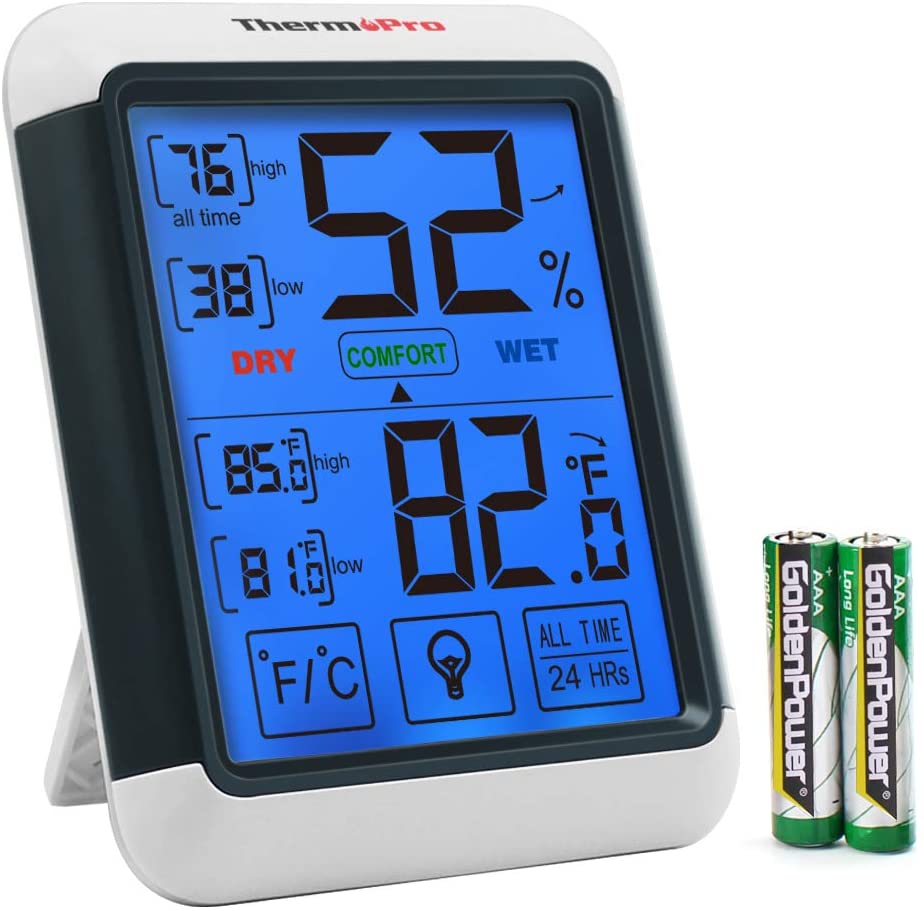
What Should Indoor Humidity Be?
Indoor relative humidity should sit between 30% and 50%, and should not exceed 60%. That is the EPA’s guidance in A Brief Guide to Mold, Moisture and Your Home, repeated in its Mold Course and in Care for Your Air: “Keep indoor humidity below 60 percent (ideally between 30 and 50 percent) relative humidity.”
The band is wide for a reason. There is no single correct humidity level in a house, because the two failure modes sit at opposite ends and most homes only ever have one of them. A dry, heated house in January and a damp, closed-up house in August are different problems with the same instrument pointing at them.
What matters more than hitting a precise figure is knowing which side of the band you are on and staying off the edges. A house that reads a steady 42% all winter is in better shape than one that swings between 25% and 58%, even though both spend most of their time technically inside the range.
Ideal Humidity Level by Room
The 30–50% target applies to the living space as a whole. A handful of spaces inside a house are held deliberately outside it, because something stored there needs different conditions.
| Space | Target RH | What drives the number |
|---|---|---|
| Living room, bedroom, hallway | 30–50% | EPA guidance for the occupied house; comfort and mold control |
| Nursery and bedrooms in winter | Toward the upper half, 40–50% | Dry heated air is the usual complaint; still capped by window condensation |
| Bathroom | Spikes are fine, recovery is not optional | A shower drives RH near saturation; the fan’s job is getting it back under 60% quickly |
| Kitchen | 30–50% between cooking | Cooking and dishwashers add moisture in bursts; extraction handles it |
| Basement | Below 60%, ideally 30–50% | Cool surfaces plus summer air is the classic condensation trap |
| Crawl space | Below 60% | EPA advises a plastic ground cover over bare dirt and good ventilation |
| Attic | Follows the outdoors; watch for condensation on sheathing | Ventilated attics are not conditioned space; moisture arrives from the house below |
| Cigar humidor | 65–72% | Cigars dry out and split below this band |
| Guitar or violin case | 45–55% | Roughly the moisture content the instrument was built at |
| Wine cellar | Around 60% | Corks shrink dry and mold wet |
| Reptile terrarium | 20–90% by species | Set by the animal’s native climate, not by the room |
| Greenhouse | Around 80% | Plant transpiration and disease pressure, not human comfort |
The practical consequence is that a single home hygrometer on the hallway wall cannot report on the humidor, the guitar case or the basement. Those are separate microclimates, and each needs its own sensor if the contents matter.
What Too Much and Too Little Indoor Humidity Actually Do
The symptoms at each end are distinct enough that you can often guess which way a house has drifted before you look at the display.
| Too dry (below ~30% RH) | Too humid (above ~60% RH) |
|---|---|
| Static shocks off handles and carpets | Condensation on windows, then black spotting on the frames |
| Dry, itchy skin, chapped lips, sore throat on waking | A musty smell in closets and along outside walls |
| Timber floors gapping; furniture joints loosening | Mold on cold outside-wall surfaces and behind furniture |
| Instruments going out of tune and, eventually, cracking | Dust mite populations rising in bedding and carpet |
| Houseplants wilting despite watering | Air that feels warmer and stuffier than the thermometer says |
The damp side has a hard deadline attached to it. The EPA’s guidance is that “if wet or damp materials or areas are dried 24-48 hours after a leak or spill happens, in most cases mold will not grow.” That window is the reason a home hygrometer is worth reading after a leak rather than a week later — the number tells you whether the drying is actually working.
Winter Moves the Target Down
The usual mistake in a cold climate is aiming for 50% RH in January because 50% is inside the recommended band. It is, and it will still run condensation down the windows.
Cold outdoor air holds very little moisture. When it leaks into a house and is heated, its relative humidity collapses — which is why heated houses are dry. Add moisture back and it condenses on the coldest surface available, normally the glass. The EPA reproduces ASHRAE’s maximum indoor humidity levels for exactly this situation:
| Outdoor temperature | Maximum indoor RH |
|---|---|
| +20 °F | 35% |
| +10 °F | 30% |
| 0 °F | 25% |
| −10 °F | 20% |
| −20 °F | 15% |
Read alongside the 30–50% target, the message is that the ceiling drops as it gets colder outside, and in a hard freeze the honest target is the low end of the range or below it. If the windows are wet, the house is too humid for the weather regardless of what the recommended band says.
The same logic runs in reverse in summer. Warm outdoor air carries a lot of moisture, so the problem flips from adding humidity to removing it, and the hardest room is whichever one is coolest — usually the basement.
Where to Put a Home Hygrometer
Placement changes the reading more than the instrument does. A hygrometer reads the air it is sitting in, and there is a surprising amount of air in a house that is not representative of the room.
- Interior wall, roughly at head height. Outside walls run colder, which reads high; near the floor is cooler and damper than the room you actually occupy.
- Away from vents, radiators and the back of the fridge. Anything blowing conditioned air is a local microclimate.
- Out of direct sunlight. Sun on the case warms the sensor and drives the relative humidity reading down.
- Not in the bathroom or kitchen if you want a whole-house number. Both spike routinely; both are useful to monitor separately, for a different question.
- Not on an exterior door or window frame. Draughts pull outdoor conditions across the sensor.
- The same spot every time. Comparability week to week is worth more than a theoretically perfect location.
Give a newly placed hygrometer time. Moving a unit from one room to another, or unpacking it from a shipping box, means the sensor needs to equilibrate before the number means anything — minutes for a good digital sensor, hours for an analog dial.
How Many Hygrometers Does a House Need?
One is enough to answer “is my house dry or damp?” It is not enough to answer “is anything in my house at risk?”
A reasonable set for an average home is three. One in the main living area as the reference number. One in the basement or the lowest, coolest room, because that is where condensation shows up first and where a whole-house reading is least representative. One in whichever enclosed space contains something that matters — the humidor, the instrument case, the storage room with the books and photographs.
Households with a specific complaint should place the fourth where the complaint is. Recurring mold in one bedroom, a window that fogs while others stay clear, a closet on an outside wall that smells: those are all local problems, and a hallway hygrometer will report that everything is fine while the affected corner sits ten points higher.
Relative Humidity Is Only Half the Reading
Relative humidity is relative to temperature, which is why a home hygrometer that also shows temperature is worth more than one that does not. The same amount of water vapour reads as a different percentage in a warm room and a cold one — nothing has changed except the thermometer.
Dew point is the version of the number that does not move. It is the temperature at which the air in the room would start condensing, and it is what determines whether the windows fog and whether the basement wall sweats:
| Room at 70 °F (21 °C) reading | Dew point | Condenses on any surface colder than |
|---|---|---|
| 30% RH | 37 °F (3 °C) | 37 °F |
| 40% RH | 45 °F (7 °C) | 45 °F |
| 50% RH | 50 °F (10 °C) | 50 °F |
| 60% RH | 55 °F (13 °C) | 55 °F |
| 70% RH | 60 °F (15 °C) | 60 °F |
Values calculated from the Magnus formula for a room at 70 °F. The right-hand column is the practical one: a living room at 50% RH will condense on anything colder than about 50 °F, which on a freezing night includes plenty of single-glazed windows and the inside face of an uninsulated outside wall. The EPA’s advice for that situation is to attack the surface rather than only the air — “raise the temperature of cold surfaces where moisture condenses. Use insulation or storm windows.”
Choosing a Hygrometer for the House
For household use the choice comes down to three things, and brand is not one of them.
Digital over analog, in almost every case. A capacitive digital sensor responds in seconds where a dial takes hours, and it reads temperature alongside humidity. Analog units still make sense where a battery is unwelcome or the instrument is meant to look like an instrument. The trade-offs are covered in full in our digital vs analog hygrometer comparison.
Something you can check. An accuracy figure printed on a box describes a production run, not the unit in your hand. A hygrometer you can salt-test and correct beats a better-specified one you cannot verify — see how to calibrate a hygrometer and what hygrometer accuracy figures actually mean.
Min/max memory, if you are chasing an intermittent problem. The damaging conditions in a house usually happen overnight, or while everyone is out. A unit that records the extremes catches what a spot check misses.
Remote and Bluetooth sensors are genuinely useful for a basement, crawl space or second home, where the point is not having to go and look. For a living room they are a convenience rather than a capability. If you want the wider view of instrument types, our guide to hygrometer types and their uses covers the full range, and how to measure humidity covers the measurement itself.
What is the ideal humidity level in a house?
Between 30% and 50% relative humidity, and never above 60%. That is the EPA’s recommendation for the occupied parts of a home. In cold weather the practical ceiling drops further, because moisture condenses on cold windows well before the air itself reaches 50%.
Where should I put a hygrometer in my house?
On an interior wall at roughly head height in the main living area, away from vents, radiators, direct sunlight and exterior doors. Keep it in the same place each time so readings stay comparable, and give it time to settle after moving it.
Is 60% humidity too high in a house?
It is the upper limit rather than an emergency. The EPA advises keeping indoor humidity below 60%, because above that mold and dust mites get the conditions they need. A house sitting at 60% is a house with no margin, and it will cross the line during a shower or a humid spell.
Why is my house so dry in winter?
Cold outdoor air holds very little moisture. When it leaks into the house and is heated, its relative humidity collapses, so a well-heated house in a cold climate drifts naturally into the twenties. Adding moisture back helps, but only up to the point where it starts condensing on the windows.
How many hygrometers does a home need?
One gives you a whole-house reference. Three is a better set: the main living area, the basement or lowest room, and any enclosed space holding something moisture-sensitive such as a humidor, an instrument case or stored documents. Add one wherever you have a specific damp or dry complaint.
Do home hygrometers need calibrating?
Yes. Every humidity sensor drifts, and cheap analog dials often ship several points out. The salt test takes one overnight cycle and costs nothing: sealed with damp table salt, a correct hygrometer reads about 75% RH, and any difference is your offset.
The Bottom Line
Put a home hygrometer on an interior wall in the room you actually live in, aim for 30–50% RH, and treat 60% as a hard ceiling rather than a target. In cold weather let the windows arbitrate: if they are wet, the house is too humid for the outdoor temperature no matter what the recommended range says. Add a second sensor in the basement and a third in whatever sealed box holds something you would be sorry to damage.
Then calibrate the thing once, so the number you are acting on is real.
If you are new to the instrument itself, what a hygrometer is and how it works explains the sensor types behind these numbers, and how to measure humidity covers taking a reading you can rely on.
References
- US Environmental Protection Agency. A Brief Guide to Mold, Moisture and Your Home.
- US Environmental Protection Agency. Mold Course Chapter 2: Why and Where Mold Grows.
- US Environmental Protection Agency. What are the main ways to control moisture in your home? (includes the ASHRAE maximum indoor humidity table).
- US Environmental Protection Agency. Care for Your Air: A Guide to Indoor Air Quality.

4 thoughts on “Home Hygrometer: Ideal Indoor Humidity, Room by Room”