

A hygrometer is an instrument that measures the amount of water vapour in the air. It reports the result as relative humidity — a percentage of the maximum moisture the air could hold at its current temperature. It works by exposing a moisture-sensitive element to the air and measuring how that element responds: a polymer film changes its electrical capacitance, a bundle of hair changes length, or the temperature gap between a wet and a dry thermometer changes. Nearly every hygrometer sold today is a digital one built around a capacitive sensor, and it shows temperature alongside humidity because the first number is meaningless without the second.
The name comes from the Greek hygros, meaning wet or moist. Whatever form it takes — a brass dial on a wall, a credit-card-sized display in a cigar box, a battery-powered sensor reporting to a phone — a hygrometer answers a single question: how much moisture is in this air, right now?
That question turns out to matter almost everywhere. Mould needs humidity to grow, timber and paper swell and shrink with it, cigars dry out and plants wilt without it, and human comfort sits inside a fairly narrow band. This guide covers what a hygrometer measures, how each type works inside, what people use them for, and how far you can trust the number on the display.

What Does a Hygrometer Measure?
A hygrometer measures relative humidity, written as %RH. Relative humidity compares the water vapour actually present in the air with the most that air could hold before it starts condensing, at the temperature it happens to be. Air at 50% RH is holding half of what it could.
The word relative is doing a lot of work there, and it is the source of most confusion about humidity. Warm air can hold far more water vapour than cold air, so the same quantity of moisture reads as a low percentage in a warm room and a high one in a cold cellar. Nothing about the air changed except its temperature. This is exactly why a basement reads higher than the floor above it even when both hold the same amount of water.
That is also why a hygrometer without a thermometer would be close to useless, and why virtually every model shows both.
| Quantity | What it tells you | Does a hygrometer show it? |
|---|---|---|
| Relative humidity (%RH) | How close the air is to saturation at its current temperature | Yes — this is the main reading on every hygrometer |
| Temperature | The context that makes the humidity figure interpretable | Yes, on virtually every model; combined units are sold as thermohygrometers |
| Dew point | The temperature at which this air would begin to condense on a surface | On some digital models, calculated from the other two readings |
| Absolute humidity | The actual mass of water vapour per unit volume of air | Rarely — it is a laboratory quantity, not a household one |
If you are trying to work out whether condensation will form on a cold window or a cellar wall, the dew point is the more useful number of the four. Relative humidity tells you how the air feels; dew point tells you what it will do when it meets something cold.
How Does a Hygrometer Work?
There is no single mechanism. What every hygrometer has in common is a material or an arrangement that changes in a measurable way when the moisture around it changes. The differences between types are differences in what changes, and how precisely that change can be read.
| Type | What changes | What it measures | Typical accuracy |
|---|---|---|---|
| Hair tension (mechanical) | Human or synthetic hair strands lengthen and contract as humidity rises and falls, moving a needle. | Relative humidity, read directly off a dial. | ±5–10% RH; drifts with age and needs periodic calibration. |
| Capacitive (digital) | A thin polymer film between two electrodes absorbs moisture, changing its electrical capacitance. | Relative humidity, shown on a digital display. | ±2–3% RH when calibrated; the sensor in most modern digital hygrometers. |
| Resistive (digital) | A moisture-sensitive layer’s electrical resistance changes as it absorbs water vapour. | Relative humidity, shown on a digital display. | ±3–5% RH; less common today than capacitive sensors. |
| Psychrometer (wet/dry bulb) | Water evaporating from a wet-bulb thermometer cools it; the gap to a dry-bulb thermometer widens as the air gets drier. | Relative humidity, derived from the two temperature readings. | Accurate as a reference method, but needs a wet wick and manual reading. |
| Chilled mirror | A mirror is cooled until dew forms on it and an optical detector spots the condensation. | Dew point directly, from which relative humidity is calculated. | The laboratory reference class; not a household instrument. |
Both mechanical and electronic hygrometers measure relative humidity reasonably well in a closed room, though digital sensors are generally more accurate and easier to read than analog dials. The wider family of instruments, including colour-change cards and industrial probes, is covered in types of hygrometers.
How a Digital Hygrometer Works
Almost every digital hygrometer sold today uses a capacitive sensor. Inside the housing sits a tiny sandwich: two conductive plates with a thin polymer film between them. That polymer absorbs water molecules out of the surrounding air, and the more water it holds, the more it changes the electrical capacitance between the plates.
A small circuit measures that capacitance many times a second and converts it into a relative humidity percentage using a calibration curve programmed into the chip. Because relative humidity depends on temperature, the same chip also carries a temperature sensor and corrects the reading — which is why every digital hygrometer shows both numbers.
A resistive sensor does the same job differently: instead of capacitance, it measures how easily an alternating current passes through a hygroscopic layer. Wetter layer, lower resistance. Resistive units are cheaper and slightly less precise, and are gradually being replaced by capacitive ones.
Two practical consequences follow from this design. First, the sensor has to physically exchange moisture with the air, so it needs time before the display settles after you move it to a new room. Sensirion’s widely used SHT4x sensor element responds to 63% of a step change in about four seconds in moving air, but the sealed plastic case around it is far slower, so allow ten to thirty minutes in practice. Second, the polymer ages: the same datasheet gives long-term drift as typically under 0.2 %RH per year for a premium sensor, and cheaper ones drift faster. That is why calibration matters.
How an Analog (Hair Tension) Hygrometer Works
The mechanical hygrometer is the oldest design still in everyday use, and it rests on one simple fact: organic fibres get longer when they absorb moisture. A bundle of human or synthetic hair, held under light tension, stretches by roughly two per cent as the air goes from bone dry to fully saturated. Horace Bénédict de Saussure built the first instrument on this principle in 1783, and the basic mechanism has barely changed since.
That movement is far too small to read directly, so the hair is attached to a lever and gear train that magnifies it and swings a needle across a printed dial. There is no electronics and no battery — the air itself does the work.
The trade-off is precision and stability. A dial hygrometer is typically accurate to ±5–10% RH, it responds slowly, and the fibres lose elasticity over the years, so the needle gradually reads low. Most analog units have a small adjustment screw on the back for exactly this reason.
How a Wet-and-Dry-Bulb Hygrometer Works
A wet-and-dry-bulb hygrometer, properly called a psychrometer, does not sense moisture at all. It measures evaporation.
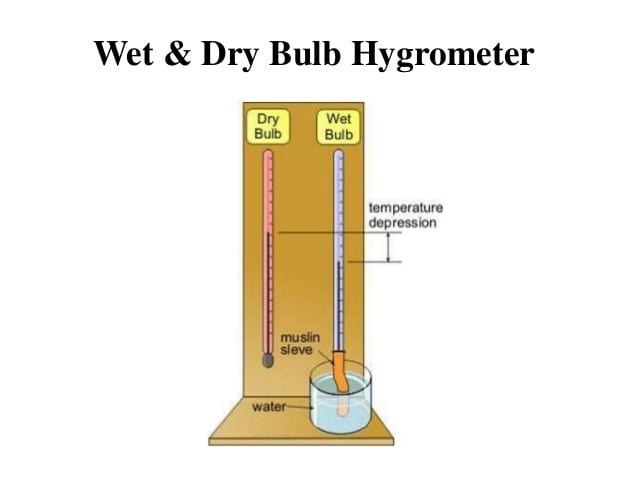
Two identical thermometers sit side by side. One is left in the open air; the other has its bulb wrapped in a wet cotton wick. Water evaporating from that wick draws heat out of the bulb, so the wet thermometer reads lower than the dry one. Dry air pulls water off the wick quickly and the gap grows; humid air slows evaporation and the gap shrinks. In fully saturated air nothing evaporates, and both thermometers read the same.
You then look the two temperatures up on a psychrometric chart to get the relative humidity. It is slower and fussier than pressing a button, but the physics is exact, which is why meteorological services still use the ventilated Assmann psychrometer as a field reference against which other instruments are checked. The laboratory is a different matter: NIST calibrates humidity with its Hybrid Humidity Generator, and the chilled-mirror instrument in the table above is the laboratory reference class.
What Is a Hygrometer Used For?
A hygrometer is used anywhere humidity has to stay inside a known band — either because something will be damaged outside it, or because people have to live in it. The target changes enormously depending on what is being protected. If you are choosing one, see our tested picks in the best hygrometer guide.
| Where it is used | Typical target | What goes wrong outside the band |
|---|---|---|
| Living areas of a house | 30–50% RH | The EPA advises keeping indoor humidity in this range; above 60% encourages mould and dust mites, while very dry air causes static, cracked woodwork and irritated airways. |
| Basement or crawl space | Below 60% RH, ideally 30–50% | Cool surfaces plus damp air means condensation and mould, and the reading is naturally higher than upstairs. |
| Cigar humidor | 65–72% RH | Too dry and the wrappers crack; too damp and the cigars mould. The band is only a few points wide. |
| Guitar or violin case | 45–55% RH | Dry air shrinks the top and lifts the frets; damp air swells the timber and dulls the tone. |
| Wine cellar | Around 60% RH (50–70%) | Below 50% dries the corks and lets air into the bottle; above 70–75% attacks labels and risks mould. |
| Greenhouse | Around 80% RH | Most crops like it humid, but fungal disease risk climbs sharply above 85–90%. |
| Reptile terrarium | 20–40% up to 70–90%, by species | Desert species get respiratory infections in damp air; rainforest species fail to shed properly in dry air. |
| Museums, laboratories and factories | Tightly specified bands | Paper, textiles, pharmaceuticals, film and steel all have moisture tolerances, monitored continuously rather than glanced at. |
The household cases share a pattern: you are not chasing an exact number, you are staying inside a range and watching for the day you drift out of it. A fuller list of domestic and commercial applications is in hygrometer uses and home uses for hygrometers.
Hygrometer vs Hydrometer vs Psychrometer
Three similar-looking words, and only two of them are related.
| Instrument | What it measures | Where you meet it |
|---|---|---|
| Hygrometer | Water vapour in the air, as relative humidity | Homes, humidors, greenhouses, weather stations |
| Hydrometer | The density or specific gravity of a liquid | Brewing and winemaking, car batteries, dairies — nothing to do with air |
| Psychrometer | Humidity, using two thermometers and evaporation | A specific type of hygrometer, used as a reference instrument |
The one to watch is hydrometer. It is a different instrument for a different job, and the two words are mistyped for each other constantly. A psychrometer, by contrast, is not a rival to a hygrometer — it is one kind of hygrometer.
How Accurate Is a Hygrometer, and Why Do Readings Drift?
Every type of hygrometer wanders over time: polymer sensors age, hair loses tension, and dust or condensation on a sensor slows its response. A reading that is five or ten points out looks perfectly plausible on the display, so the only way to know is to test it. How far you can trust a given instrument, and how much precision each job actually needs, is covered in detail in hygrometer accuracy.
The standard check is the salt test, and it needs nothing but table salt, water and a sealed bag or container:
- Put a tablespoon of salt in a bottle cap or small dish and add a few drops of water — enough to make a damp slush, not a solution.
- Place the dish and the hygrometer together in a sealed zip bag or airtight container, without letting them touch.
- Leave it somewhere at a stable room temperature for at least eight hours; twelve is better.
- Read the display through the bag. A saturated sodium chloride solution holds the air at about 75% RH at room temperature — Greenspan’s 1977 study for the US National Bureau of Standards puts it at 75.47% at 20 °C and 75.29% at 25 °C — so a healthy hygrometer should show 75, give or take its stated tolerance.
Tip: If it reads 68 instead of 75, the instrument is not broken — it is seven points low. Either adjust it, or write “+7” on a piece of tape on the back and add that to every future reading. Our guide to how to calibrate a hygrometer walks through both options.
Placement matters just as much as calibration. Keep a hygrometer away from windows, exterior walls, radiators, air vents and doorways — all of them create a local microclimate that has little to do with the humidity of the room you actually care about. The full procedure for taking a reading you can rely on is in how to measure humidity.
What is a hygrometer?
A hygrometer is an instrument that measures the amount of water vapour in the air and reports it as relative humidity, a percentage of the maximum that air could hold at its current temperature. Types range from simple hair-tension dials and digital capacitive sensors to psychrometers and laboratory chilled-mirror instruments.
What does a hygrometer measure?
It measures relative humidity, expressed in %RH. Because the maximum moisture air can hold rises with temperature, every hygrometer also measures temperature, either to correct its own reading or to let you interpret it. Some digital models additionally calculate the dew point, which is the more useful figure if you are worried about condensation.
How does a hygrometer work?
By exposing a moisture-sensitive element to the air and measuring how it changes. In a digital hygrometer a polymer film absorbs water vapour and alters the capacitance between two electrodes. In an analog one, hair fibres stretch and move a needle. In a psychrometer, water evaporating from a wet thermometer cools it below a dry one. Each change is converted into a relative humidity percentage.
What is a hygrometer used for?
For keeping humidity inside a known band. At home that means the EPA range of 30 to 50% RH; a cigar humidor wants 65 to 72%, a guitar case 45 to 55%, a wine cellar around 60%, and a greenhouse around 80%. Museums, laboratories and factories monitor tighter bands continuously.
What is the difference between a hygrometer and a hydrometer?
A hygrometer measures moisture in the air. A hydrometer measures the density of a liquid and is used in brewing, winemaking and battery testing. They are unrelated instruments with confusingly similar names. A psychrometer is a third thing again: a type of hygrometer that uses a wet and a dry thermometer.
How long does a hygrometer take to give an accurate reading?
Give it 10 to 30 minutes in a new location, and longer if you have moved it between very different environments. The sensor has to physically exchange moisture with the surrounding air before the number settles, so the first reading after switching it on means very little. Sensors also drift with age, so check yours against the salt test once a year.
References
- US Environmental Protection Agency. A Brief Guide to Mold, Moisture and Your Home.
- Sensirion. Datasheet SHT4x — Humidity and Temperature Sensor.
- Greenspan, L. (1977). Humidity Fixed Points of Binary Saturated Aqueous Solutions. Journal of Research of the National Bureau of Standards — A. Physics and Chemistry, 81A(1).
- National Institute of Standards and Technology. Humidity Calibration Services at NIST.

8 thoughts on “What Is a Hygrometer and How Does It Work?”