

Humidity is measured with a hygrometer, which reports the result as relative humidity (% RH). For almost everyone the practical answer is a digital hygrometer: put it in freely circulating air away from vents, windows and sunlight, give it ten to thirty minutes to settle, and read the temperature alongside it. A psychrometer — a wet and a dry thermometer read together — is the reference method that needs no electronics. Everything else, including phone apps and the glass-of-ice-water trick, tells you something about the air but is not a measurement.
The instrument matters less than most people expect. A calibrated budget hygrometer in the right place beats an expensive one on a sunny windowsill, and the most common reason a humidity reading is wrong has nothing to do with the sensor at all.
This guide compares the five ways to measure humidity, says what each one needs and what it is actually worth, then walks through taking a reading in a house that you can rely on.
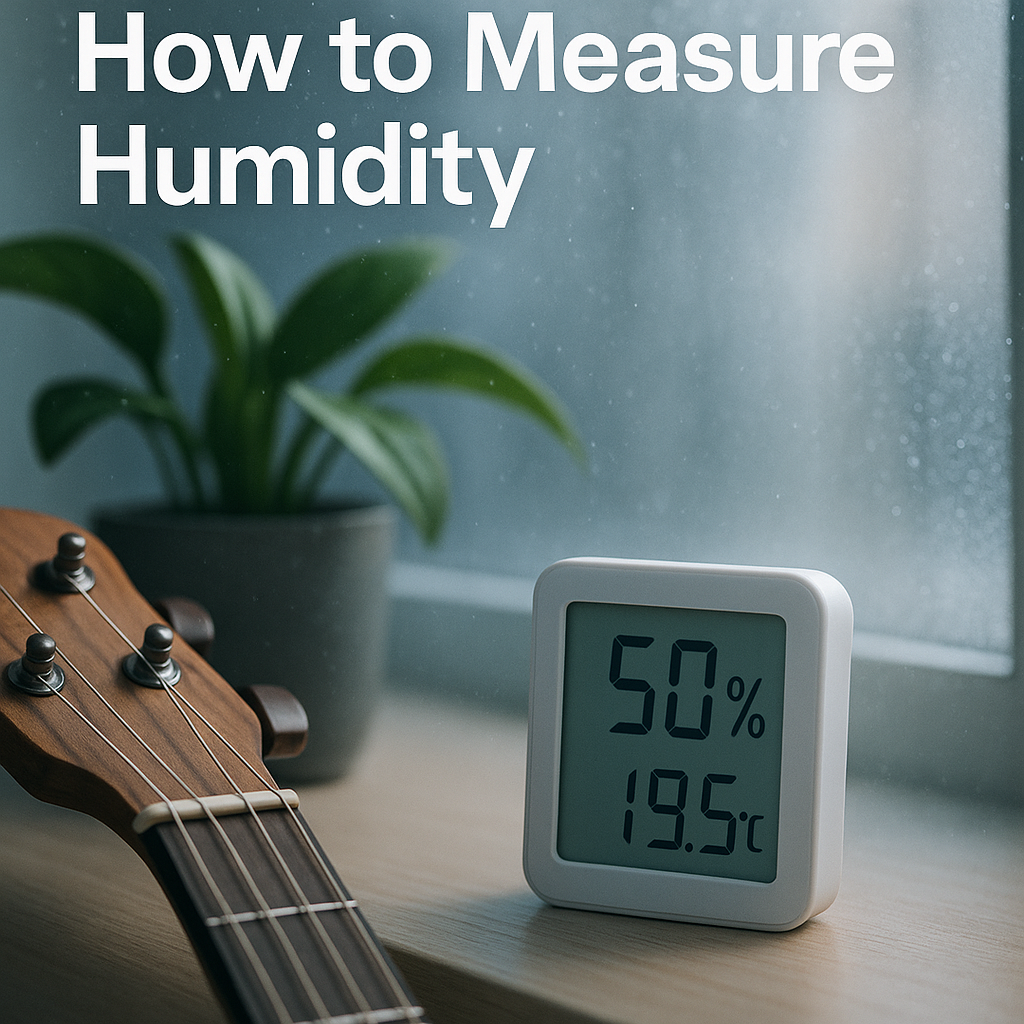
What Instrument Measures Humidity?
The instrument is called a hygrometer. Everything beyond that is a question of which physical principle it uses to turn moisture into a number, and every principle trades accuracy against speed, cost and convenience.
A psychrometer is a particular type of hygrometer that uses two thermometers rather than a moisture-sensitive element. A hydrometer, despite the near-identical name, measures the density of liquids and has nothing to do with air.
The 5 Ways to Measure Humidity, Compared
Here is the whole field side by side before we go through each one.
| Method | What you need | Typical accuracy | Time to a reading | When to use it |
|---|---|---|---|---|
| Digital hygrometer | A capacitive or resistive unit, ideally calibratable | ±2–5% RH once calibrated | 10–30 minutes to settle | The default for any indoor space you care about |
| Psychrometer | Two thermometers, a cotton wick, water, a psychrometric chart | Field-reference grade if read carefully | A few minutes of active work | Checking another instrument; teaching; no power available |
| Analog dial hygrometer | A hair-tension or coil dial | ±5–10% RH, worse when old | Hours to respond fully | A battery-free at-a-glance indicator, not a measurement |
| Ice-water glass test | A glass, ice, water | Not a measurement — a yes/no indicator | 5–10 minutes | Deciding whether the air is unusually dry, with nothing to hand |
| Phone app or weather data | A smartphone | Outdoor figure for your area, not your room | Seconds | Outdoor context only — never for indoor humidity |
Two things stand out. The gap between a calibrated digital hygrometer and an old analog dial is larger than most people assume, and the two methods that need no equipment do not actually measure anything. That is not a reason to ignore them, but it is a reason not to act on them.
Method 1: Digital Hygrometer
What you need: one digital hygrometer, ideally one you can calibrate.
Almost every digital hygrometer uses a capacitive sensor: a polymer film between two electrodes absorbs water vapour, and the resulting change in capacitance is converted to a percentage. Resistive sensors do the same job by measuring conductivity through a hygroscopic layer, and are cheaper and slightly less stable.
How accurate it is: a good household unit claims ±2–3% RH and a budget one ±5%. The sensing elements themselves are better than that — Sensirion specifies its widely used SHT4x family at ±1.8% RH typical — but the case, the ageing and the placement give much of it back. Sensors drift, typically under 0.2% RH per year for a premium part and faster for a cheap one, so an uncalibrated unit of unknown age is worth much less than its box claims. The full picture is in hygrometer accuracy.
When to use it: essentially always, indoors. It is the only method on this list that gives you a continuous number you can watch over time, and min/max memory matters because the damaging extremes happen overnight when nobody is looking.
Before you trust any digital hygrometer, calibrate it. Seal it in a bag for eight to twelve hours with a bottle cap of damp table salt. A saturated sodium chloride solution holds the air at about 75% RH at room temperature — Greenspan’s 1977 study for the US National Bureau of Standards puts it at 75.47% at 20 °C and 75.29% at 25 °C. Whatever the display shows is your offset. The full procedure is in how to calibrate a hygrometer.
Method 2: Psychrometer (Wet and Dry Bulb)
What you need: two identical thermometers, a cotton wick or shoelace, distilled water, and a psychrometric chart or calculator.
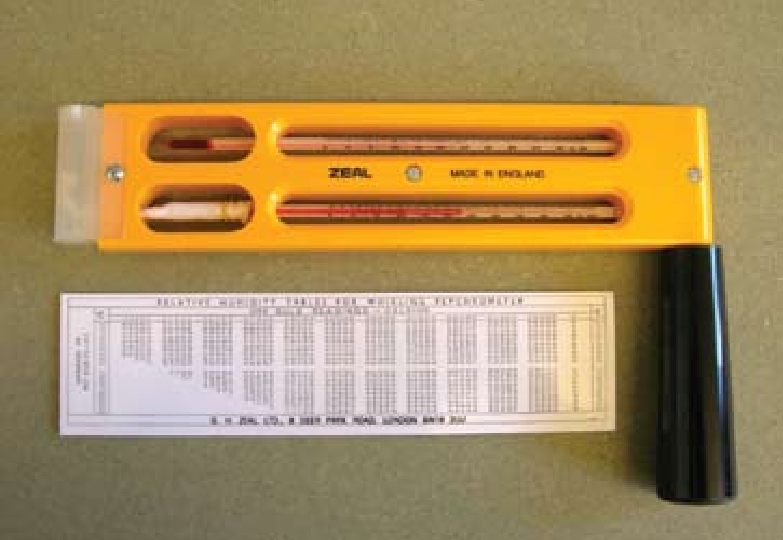
One thermometer is left dry and reads air temperature. The other has its bulb wrapped in a wet wick. Water evaporating from the wick draws heat away, so the wet bulb reads lower. Dry air evaporates water quickly and the gap grows; humid air slows evaporation and the gap shrinks. At 100% RH nothing evaporates and both thermometers agree.
To take the reading, wet the wick with distilled water, move air across it steadily for a minute or two — a sling psychrometer is whirled on its handle for exactly this reason — then read the wet bulb at its lowest point and the dry bulb at the same moment. Look the pair up on a psychrometric chart to get relative humidity.
How accurate it is: excellent, which is why meteorological services use the ventilated Assmann psychrometer as a field reference to check other instruments against. The laboratory is a different matter: NIST calibrates humidity with its Hybrid Humidity Generator, and the chilled-mirror hygrometer is the laboratory reference instrument. The accuracy depends entirely on technique: a wick that has dried out, water that is not at air temperature, or too little airflow all push the reading wrong.
When to use it: to verify a hygrometer you are unsure about, when no power is available, or when you want the number to come from physics rather than a factory calibration curve. Our guide to what a psychrometer is covers the method and its limitations in more detail.
Method 3: The Ice-Water Glass Test
What you need: a glass, ice cubes and water. That is the entire appeal.
Fill a glass with ice and water, stir it, and leave it in the room — not the kitchen, not near a kettle — for about five minutes. Then look at the outside of the glass. If condensation forms, the dew point of the room air is above the temperature of the glass surface. If the glass stays dry, the air is very dry indeed.
How accurate it is: it is not a measurement, and it is worth understanding why. An ice-water glass sits close to 0 °C and warms towards perhaps 5 °C as it stands. In a room at 20 °C, a dew point of 0 °C corresponds to about 26% RH and a dew point of 5 °C to about 37%. So the glass fogs whenever indoor humidity is above roughly a quarter to a third — which, in a normal house, is nearly always.
The informative result is the dry glass. Condensation tells you almost nothing, because almost any liveable indoor air produces it. A glass of ice water that stays completely dry after five minutes is real evidence that the room is below roughly 26–37% RH, depending on how cold the glass actually is — dry enough to crack furniture and irritate airways, and worth acting on.
When to use it: when you have no instrument at all and want to know whether the air is abnormally dry. Never as a number, and never as a basis for buying a humidifier.
Method 4: Smartphone Sensors and Humidity Apps
What you need: a phone. And this is the method to be most sceptical about.
The great majority of smartphones contain no ambient humidity sensor at all. A handful of Android handsets from the mid-2010s did include one, and the feature was quietly dropped; the temperature sensors that phones do carry monitor the battery and processor, not the room.
So what are the apps reporting? Almost always, a figure pulled from an online weather service for your GPS location. That is the outdoor relative humidity somewhere near you, which is frequently twenty or thirty points away from the air inside a heated house. An app showing 78% while your living room sits at 40% is not malfunctioning — it is answering a different question.
How accurate it is: for indoor humidity, unusable. For outdoor conditions in your area, as good as the weather station it is quoting.
When to use it: for outdoor context, and to decide whether opening a window will help or hurt — which is a genuine use, particularly in a basement in summer, where ventilating with warm humid air makes the problem worse. If you want a phone readout of the room you are actually in, the answer is a Bluetooth or Wi-Fi sensor that reports to the phone, which is a hygrometer with a radio in it.
Method 5: Local Weather Data
What you need: nothing but an internet connection.
Published relative humidity for your town comes from a properly sited, maintained and calibrated instrument, usually at an airport or an official weather station. It is reliable for what it describes: the outdoor air, at that site, at that time.
How accurate it is: good outdoors, meaningless indoors. The moment air enters a heated building its temperature rises and its relative humidity falls, even though the amount of water in it has not changed. That is the whole reason indoor and outdoor figures differ so sharply in winter.
When to use it: alongside temperature and dew point, for weather context and ventilation decisions.
How to Measure Humidity in Your House, Step by Step
Assuming you have a digital hygrometer, most bad readings come from four avoidable mistakes.
- Put it in representative air. Away from direct sunlight, radiators, air-conditioning vents, exterior walls, doorways, kitchens and bathrooms. Roughly at chest height, with air able to circulate around it. Each of those excluded spots has its own microclimate that is not the room you are trying to measure.
- Let it settle. The sensor has to physically exchange moisture with the air. Allow ten to thirty minutes in a normal room, and considerably longer if the instrument has come from a cold car or a different floor of the house.
- Read the temperature at the same time. The same quantity of water vapour gives a different percentage at a different temperature, so a humidity figure without a temperature is half a measurement. Combination units are sold as thermohygrometers.
- Calibrate before you trust it. Sensors drift and cheap ones can arrive wrong out of the box. The salt test costs nothing and takes one overnight cycle.
For anything larger than a single room, one sensor is rarely enough. A damp basement corner and an upstairs bedroom can differ by twenty points, so two or three cheap sensors left in place tell you far more than one good one carried around. Where to put them in a whole house is covered in the home hygrometer guide.
How to Read the Result: %RH, Dew Point and Absolute Humidity
Humidity can be expressed in several units, and mixing them up is the most common source of misread numbers.
| Measure | Unit | What it tells you |
|---|---|---|
| Relative humidity | Per cent (% RH) | How close the air is to saturation at its current temperature. The number on almost every hygrometer. |
| Dew point | °C or °F | The temperature the air must cool to before it condenses. The best guide to condensation risk and to how humid it feels. |
| Absolute humidity | Grams per cubic metre | The actual mass of water vapour in a volume of air. Not measured against the saturation point the way % RH is, but it does change as air expands or contracts: heat the same air and the grams per cubic metre fall without any water leaving. Rarely shown on consumer devices. |
| Specific humidity | Grams per kilogram | The mass of vapour per mass of air. This is the figure that is genuinely independent of temperature, because heating air changes its volume but not its mass. Used in meteorology and HVAC engineering rather than at home. |
Relative humidity is a ratio, so its unit is simply a percentage — there is no gram or degree involved. That is precisely why it changes when nothing but the temperature does: warm the air and the denominator grows, so the percentage falls.
Dew point is the more useful figure when you care about condensation. A dew point below about 60 °F (15.6 °C) is generally perceived as comfortable; above about 65 °F (18.3 °C) the air starts to feel noticeably humid. When air temperature and dew point are equal, relative humidity is 100% and condensation can begin — which may show up as dew, fog, or water running down a cold window rather than as rain. The terminology guide covers the related terms.
On an analog dial, read the needle straight on rather than at an angle, and remember that a dial with no adjustment screw and no recent calibration is an indicator, not a measurement. The trade-offs are set out in the digital versus analog comparison, and the wider family of instruments in 11 types of hygrometer.
What Humidity Level Should You Aim For?
The US Environmental Protection Agency advises keeping indoor humidity roughly between 30% and 50% RH, though the right figure depends on climate, season, the building and what you are protecting. Sustained readings above about 60% encourage condensation, mould and dust mites; below about 30%, dry air causes static, dry skin and irritated airways, and can crack wood and musical instruments.
Specific environments have their own targets. A cigar humidor runs far wetter than a living room, a greenhouse wetter still, and a reptile terrarium depends entirely on the species. A wine cellar sits between the two extremes.
Outdoor relative humidity is useful weather context but should always be read alongside temperature and dew point. When humidity is high, sweat evaporates more slowly and the body’s ability to cool itself drops, which is why a humid 28 °C feels considerably worse than a dry one.
Humidity, heating and indoor climate
Indoor humidity is also closely connected to how a home is heated and ventilated. Heating changes relative humidity because warmer air can hold more water vapour, while poor ventilation can allow moisture to accumulate. If you are trying to improve both indoor comfort and energy efficiency, it is useful to look at the heating system and ventilation strategy together.
For Belgian homeowners, Energiehulp.be’s guide to heat pumps explains the main options, costs and considerations when choosing a heat pump.
Common Mistakes That Ruin a Humidity Reading
- Reading it too soon. The first number after switching a hygrometer on, or after carrying it into a room, means nothing.
- Putting it on an exterior wall or windowsill. Both are colder than the room, so both read higher than the room.
- Measuring in the bathroom or kitchen and treating it as the house. Those rooms spike for an hour and prove nothing about the rest of the building.
- Comparing two hygrometers instead of calibrating. It tells you they disagree, which you already suspected, and gives you no way to decide which is right.
- Ignoring the temperature. The same air reads 40% in a warm room and 60% in a cool one. Nothing changed but the thermometer.
- Trusting a phone app for indoor air. It is almost certainly quoting the outdoor weather station.
What instrument is used to measure humidity?
A hygrometer. Digital hygrometers use a capacitive or resistive sensor, mechanical ones use a moisture-sensitive fibre, and a psychrometer derives humidity from the difference between a dry-bulb and a wet-bulb thermometer. A hydrometer, despite the similar name, measures liquid density and is a different instrument entirely.
How do you measure humidity at home?
Place a digital hygrometer in freely circulating air, away from sunlight, radiators, vents, exterior walls and doorways, at roughly chest height. Allow ten to thirty minutes for the reading to settle and read the temperature alongside it. Calibrate the unit with the salt test before you rely on the number.
Can you measure humidity without a hygrometer?
Properly, only with a psychrometer: two thermometers, one with a moistened wick, read against a psychrometric chart. The glass-of-ice-water trick is an indicator rather than a measurement, and it is only informative when the glass stays dry, which means the room is unusually dry.
Can my phone measure humidity?
Almost certainly not. Very few smartphones contain an ambient humidity sensor, and the temperature sensors they do have monitor the battery and processor. Humidity apps generally report the outdoor figure from a weather service for your location, which can be tens of points away from the air in your room. A Bluetooth sensor paired to the phone is a real solution; an app on its own is not.
What unit is humidity measured in?
Relative humidity is a ratio and is expressed as a percentage, written %RH. Dew point is a temperature, in degrees Celsius or Fahrenheit. Absolute humidity is a mass per volume, in grams per cubic metre, and specific humidity a mass per mass, in grams per kilogram. Household hygrometers show the first and sometimes the second.
How accurate are humidity measurements?
A calibrated consumer digital hygrometer is typically within 2 to 3 percentage points of relative humidity, and a budget one within about 5. Inexpensive analog dials can be out by 10 points or more. Accuracy also degrades over time, which is why periodic calibration matters more than the figure printed on the box.
How often should humidity be measured?
Continuously, if what you are protecting is sensitive. A min/max memory function is valuable because the damaging extremes usually occur overnight or while nobody is present, and a spot check at the wrong moment will miss them entirely.
References
- US Environmental Protection Agency. A Brief Guide to Mold, Moisture and Your Home.
- Sensirion. Datasheet SHT4x — Humidity and Temperature Sensor.
- Greenspan, L. (1977). Humidity Fixed Points of Binary Saturated Aqueous Solutions. Journal of Research of the National Bureau of Standards — A. Physics and Chemistry, 81A(1).
- National Institute of Standards and Technology. Humidity Calibration Services at NIST.

4 thoughts on “How to Measure Humidity: 5 Methods Compared”