

As an Amazon Associate we earn from qualifying purchases. Check the linked retailer for the current price, model and availability.
Choose a hygrometer for the place you will use it. Start with the four scenarios below, then compare the individual models. For a home, prioritize a readable display and useful history; for a humidor, check fit, the stated accuracy range and adjustment options; for remote use, verify connectivity and alerts.
Choose by use · Check the specifications · Understand accuracy
Which Hygrometer Should You Buy? Match It to the Job
Two questions decide which hygrometer you need: how narrow is the humidity band you are protecting, and will you be standing in front of the display when the reading matters? A narrow acceptable band makes verified performance particularly important. A room you rarely enter needs a remote sensor; a place you are not in at all needs wifi. That sorts almost every buyer into one of four cases.
Home and living spaces
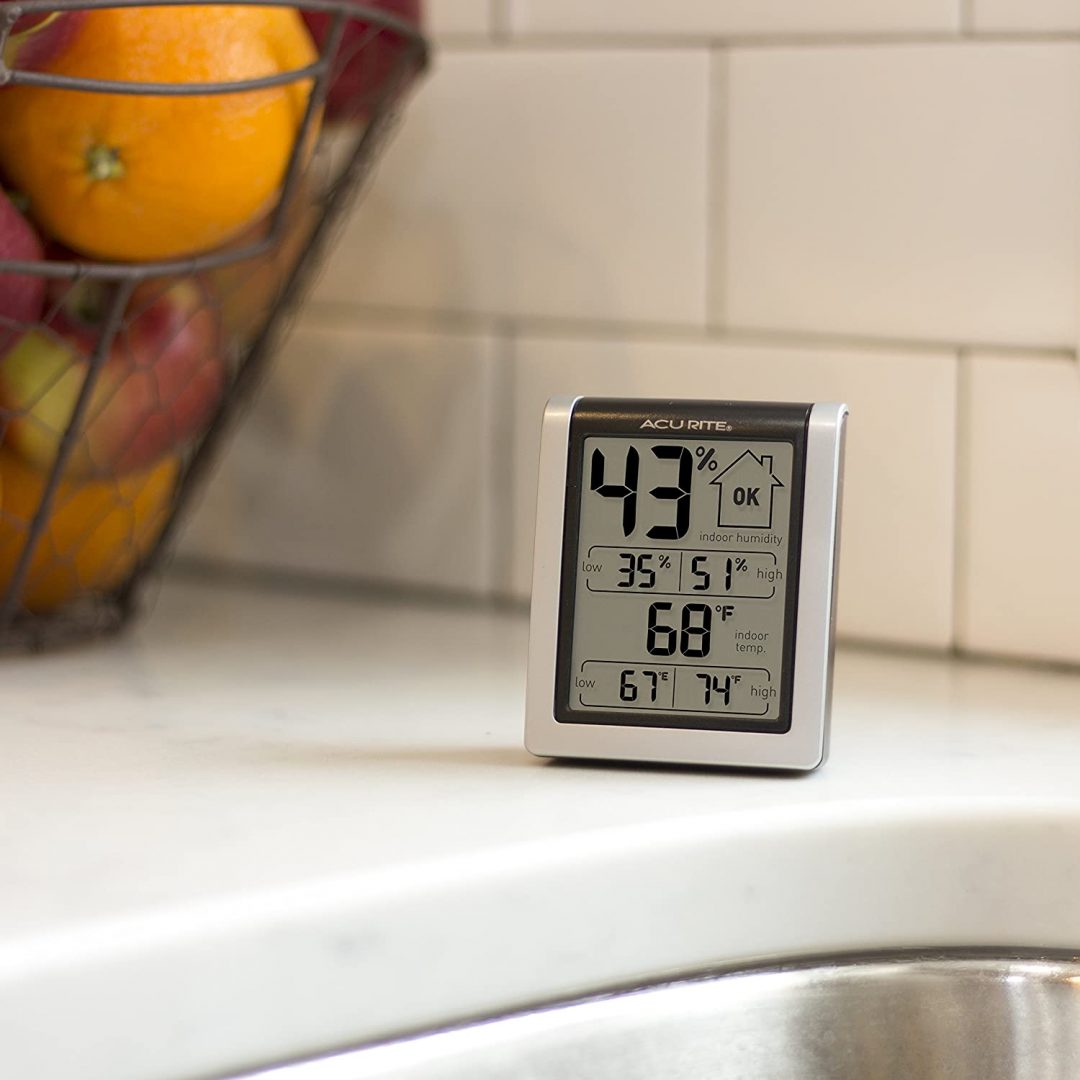
Target: 30–50% RH — a band twenty points wide
What the job needs: a temperature reading beside the humidity, and a daily high and low so the overnight peak is not missed. Consider the specified error when a reading approaches an action threshold.
Why this one: it is among the least expensive of the ten units we review, shows temperature, records the daily high and low, and has a stand, clip and magnet so it can sit where the air actually is. It has no user adjustment mode; follow the model instructions and treat a reference check as evidence at that test point only.
Cigar humidor
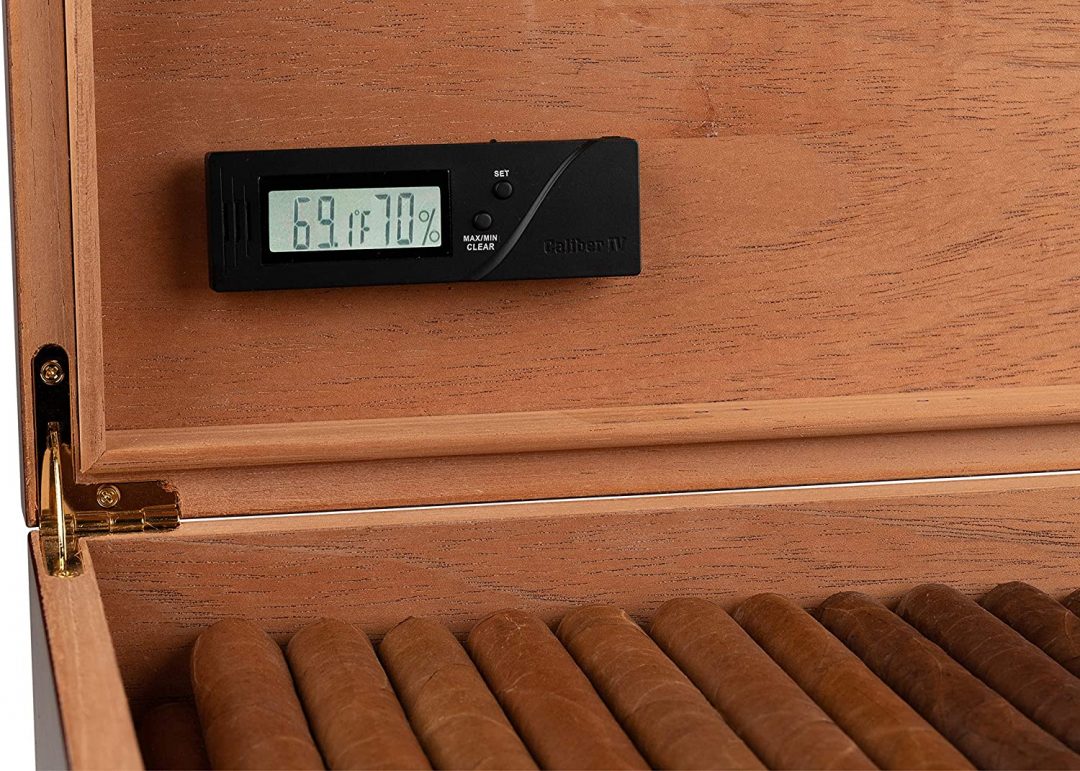
Target: 65–72% RH — a band only a few points wide
What the job needs: calibration you can adjust, and a body slim enough to sit among the cigars. A reading five points low can hide a meaningful difference from your chosen storage target.
Why this one: user-adjustable calibration, a slim 4 × 1.3 × 0.4 in case on a magnetic mount that lifts out for a salt test, and three-day high/low averages for humidity and temperature. Prefer a dial with no battery? The Cigar Oasis Analog is the adjustable mechanical alternative.
Basement or crawl space
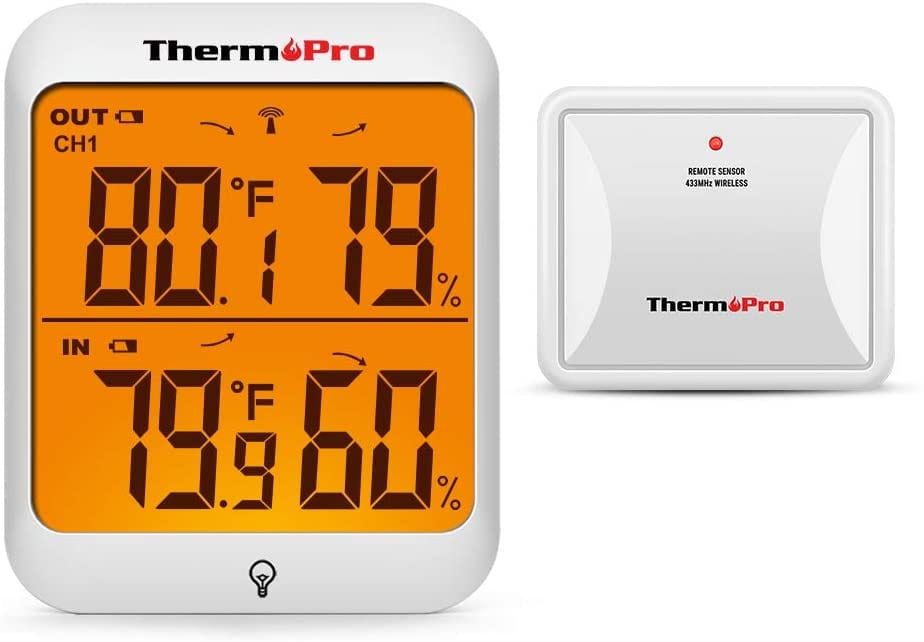
Target: below 60% RH, ideally nearer 50%
What the job needs: a sensor that lives downstairs and a display that lives where you do. Basement humidity peaks on humid nights, and the usual failure is nobody going down to look.
Why this one: the rain-proof remote sensor sits in the basement and the base station shows its reading, with max/min memory, in the kitchen or hallway. The sensor is rated for 10–99% RH and up to three can be paired, so the dampest corner can have its own. The stated 200 ft range is for open air — a floor and a concrete wall shorten it, so test the link before fixing the sensor in place.
Remote monitoring
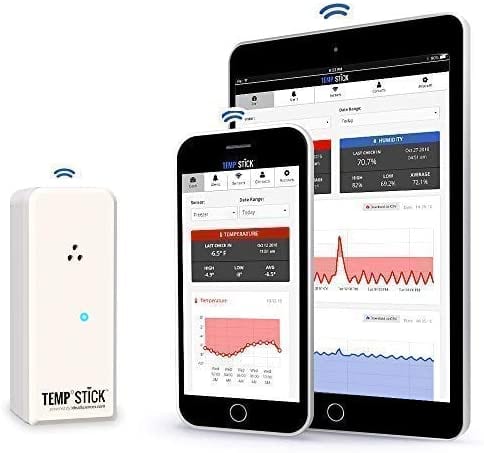
For a holiday home, rental, greenhouse or off-site storage
What the job needs: the reading has to reach you rather than wait for you. That means a wifi hygrometer, alerts that fire on a threshold you set, and a history you can scroll back through.
Why this one: it connects straight to 2.4 GHz wifi with no hub, sends text, email and app alerts when humidity or temperature crosses your limit, logs the history, and carries no subscription fee. It is the most expensive unit here, and worth it only if you are genuinely away. For alerts and history while you are at home, the Govee Bluetooth costs a fraction — but its app only updates within Bluetooth range.
Hygrometer Comparison: Stated Accuracy, Calibration and Connectivity
On paper, the tightest humidity specifications among these ten are the SMARTRO SC42 (±2% RH across 1–99%) and the AcuRite 01083M (±2% RH between 10% and 90%), followed by the ThermoPro TP63A and TP50 (±2% between 30% and 80%). The AcuRite 00613, Govee H5075 and Temp Stick are specified at ±3%. A specification describes a new unit under the maker’s test conditions, not the one in your hand, so check yours with a salt test before you rely on it near a limit.
| Model | Stated RH accuracy | Range | User adjustment | Connectivity · history | Best for |
|---|---|---|---|---|---|
| AcuRite 00613 | ±3% (20–80% RH); ±4–5% outside that | 16–98% | Not stated by the maker | None · daily high/low | Budget room monitor |
| SMARTRO SC42 | ±2% (1–99% RH) | 1–99% | Yes, manual calibration | None · 24-hour and all-time high/low | Tightest stated spec on a basic display |
| ThermoPro TP55 | Not published by the maker | 10–99% | Not stated | None · 24-hour and all-time max/min | Large backlit touchscreen |
| Temp Stick | ±3% (maker’s product page) | 0–100% | Offset set in the app | Wifi · cloud history and alerts | A place you are not in |
| AcuRite 01083M | ±2% (10–90% RH); ±4% outside that | 1–99% | Yes, manual calibration | None · 24-hour and all-time high/low | Home use with adjustment |
| ThermoPro TP63A | ±2% (30–80% RH); ±3% outside that | 10–99% | Not stated | Remote RF sensor · max/min | Basement or crawl space |
| ThermoPro TP50 | ±2% (30–80% RH); ±3% outside that | 10–99% | No offset in the manual; maker suggests a salt-test check | None · max/min | Simplest low-cost room gauge |
| Govee H5075 | ±3% | 0–99% | Offset set in the app | Bluetooth · app history, CSV export | Alerts and history at home |
| Cigar Oasis Analog | ±1% (maker’s claim) | Not published | Yes, adjustable dial | None | Humidor without a battery |
| Cigar Oasis Caliber IV | Not published | Not published | Yes, button calibration | None · 3-day high/low averages | Desktop humidor |
Figures as published by AcuRite, SMARTRO, ThermoPro (now TempPro), Temp Stick, Govee and Western Humidor on their product pages and manuals, checked 9 October 2026. “Not published” means we could not find a figure from the maker. Read how accurate hygrometers really are for what a ±2% or ±3% spec means in practice.
Before you buy: compare these five things
| Criterion | What to check | Next step |
|---|---|---|
| Accuracy | The complete instrument’s specification at your expected humidity and temperature; typical and maximum error are different. | Read the accuracy guide |
| Adjustment | Whether the exact model allows an offset, and how the manufacturer says to verify it. Adjustment does not prove accuracy across the whole range. | Choose a checking method |
| Display and history | Readable humidity and temperature; min/max or logging if you need to investigate changes between visits. | Home selection guide |
| Fit and placement | Dimensions, mounting, airflow and a position representative of the space. | Humidor criteria |
| Remote access and total cost | Bluetooth range versus remote internet access, gateway requirements, batteries and any ongoing service charges. | Basement placement and monitoring |
Best value: pay for the functions you need, then check the current delivered price and return policy. A higher price, an extra decimal place or an app does not by itself establish better accuracy.
How to read our recommendations: the selections below are editorial comparisons of listed features and published information. This update adds no hands-on test results or laboratory accuracy rankings. A product specification is not a measurement of the unit you receive.
What Is a Hygrometer?
A hygrometer is a device that measures the level of humidity in the atmosphere. Also known as a humidity meter or humidity gauge, hygrometers measure the amount of moisture in a specific environment. Our full explainer covers what a hygrometer is and how each type works, from capacitive sensors to psychrometers.
Relative humidity (% RH) compares the water vapour actually in the air with the maximum that air could hold at the same temperature. Because warm air holds more moisture than cold air, an RH figure only means something alongside a temperature reading — which is why most modern hygrometers display both. The related terms worth knowing are absolute humidity (grams of water vapour per cubic metre) and dew point, the temperature at which air becomes saturated and condensation begins.
Most digital hygrometers use a capacitive sensor, where absorbed moisture changes the electrical capacitance of a polymer layer, or a resistive sensor, where moisture changes electrical resistance. Mechanical models use a moisture-sensitive material — traditionally human hair — that changes length as humidity rises and falls. A psychrometer compares a dry-bulb and a wet-bulb thermometer and derives humidity from the difference.
There are a number of different types of hygrometers, including digital (also known as electrical) hygrometers, mechanical hygrometers, psychrometers, and dew point hygrometers. Digital hygrometers are the most commonly used hygrometers. They’re most often used in greenhouses, industrial premises, and other outdoor environments, for fast and accurate humidity readings. There are a few different types of personal and indoor-use humidity meters that are used for keeping food storage areas moisture-free, monitoring wine cellars, and preserving cigars.
Below we walk through ten hygrometers worth considering — from budget room monitors to wireless sensors and humidor-specific gauges — followed by a buyer’s guide covering which specifications actually matter and what humidity level to aim for.
Best Hygrometer Reviews
Below are ten hygrometers grouped by what they are actually good at, from basic room monitors to wireless sensors and humidor-specific gauges. These are selections based on published specifications, sensor type, calibration options and intended use — not laboratory testing. Specifications, availability and pricing change frequently, so confirm current details with the retailer before buying.
#1 | AcuRite 00613 Digital Hygrometer
First up on our list is the AcuRite 00613 Digital Hygrometer & Indoor Thermometer. The AcuRite is one of the most popular digital hygrometers available today, and for good reason. Not only is it easy on the budget, AcuRite specifies it to ±3% RH between 20% and 80%.
What We Like
This all-in-one digital hygrometer and thermometer is compact, accurate, and user-friendly. It features an easy-to-read display that allows you to quickly access temperature and humidity readings whenever you want.
You can place it practically anywhere, as it has a flat stand to place on the counter or table, a clip to attach to a vertical surface, and a magnet to easily place it on a metal surface like your fridge.
One cool feature on this hygrometer is the daily record report. You can quickly view the high and low humidity and temperature levels from the day. Plus, you can easily match your humidity levels against high, low, or ideal conditions, making it one of the best hygrometers available.
What We Don’t Like
There wasn’t much to complain about with the AcuRite hygrometer. The only real downsides were that it doesn’t come with instructions, so you’ll have to play around with it a bit to figure out how to use all of its functions. Plus, the magnet can slip off your fridge easily since it’s attached to the clip, not the hygrometer itself.
✓ Pros
- ±3% RH stated (20–80%)
- Budget friendly
- All-in-one thermometer & hygrometer
- Flat stand, clip, and magnet
- Daily humidity & temperature readings
✗ Cons
- Doesn’t include instructions
- Magnet can sometimes slip off vertical metal surfaces like a fridge
- No backlight
#2 | SMARTRO SC42 Professional Digital Hygrometer
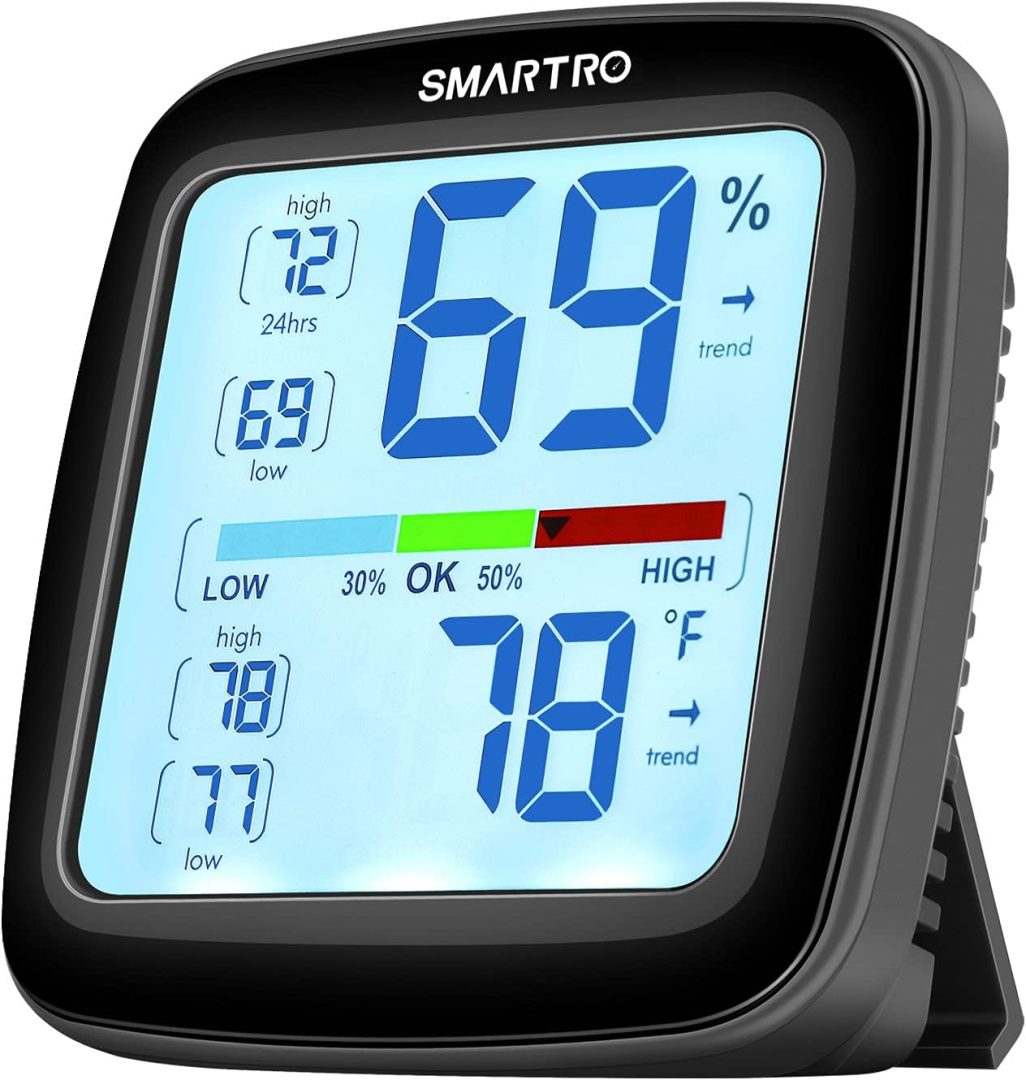
The SMARTRO SC42 is a digital hygrometer designed to monitor indoor temperature and humidity levels accurately. It features a large LCD display, data logging capabilities, and multiple mounting options.
What We Like
The SMARTRO SC42 digital hygrometer hits the mark in several areas. Firstly, its accuracy stands out. It consistently delivers precise readings for both temperature and humidity, ensuring you have a reliable understanding of your indoor environment.
Another great feature is its large, easy-to-read display. The numbers are clear and visible from a distance, making it incredibly convenient to keep an eye on temperature and humidity levels without squinting or getting closer to the device.
We also appreciate the versatility in mounting options. Whether you want to place it on a table, mount it on a wall, or attach it to a metal surface using its built-in magnet, this hygrometer offers adaptable placement choices to suit your preferences.
The inclusion of data logging is a big plus. This feature allows you to track temperature and humidity trends over time, enabling adjustments for a more comfortable environment. And let’s not forget the impressive battery life, meaning fewer interruptions for battery changes.
What We Don’t Like
Despite its strengths, the SMARTRO SC42 does have a couple of minor downsides. One notable drawback is the absence of a backlight on the display. While the numbers are clear, it can be challenging to read them in low-light conditions or at night without additional lighting.
Additionally, if you’re looking for a hygrometer with extra bells and whistles beyond measuring temperature and humidity, this might not be the ideal choice. It performs its primary functions admirably but lacks additional features that some users might desire.
✓ Pros
Accurate Readings
Large Display
Multiple Mounting Options
Data Logging
Battery Life
✗ Cons
No Backlight
Limited Additional Features
#3 | ThermoPro TP55 Digital Hygrometer
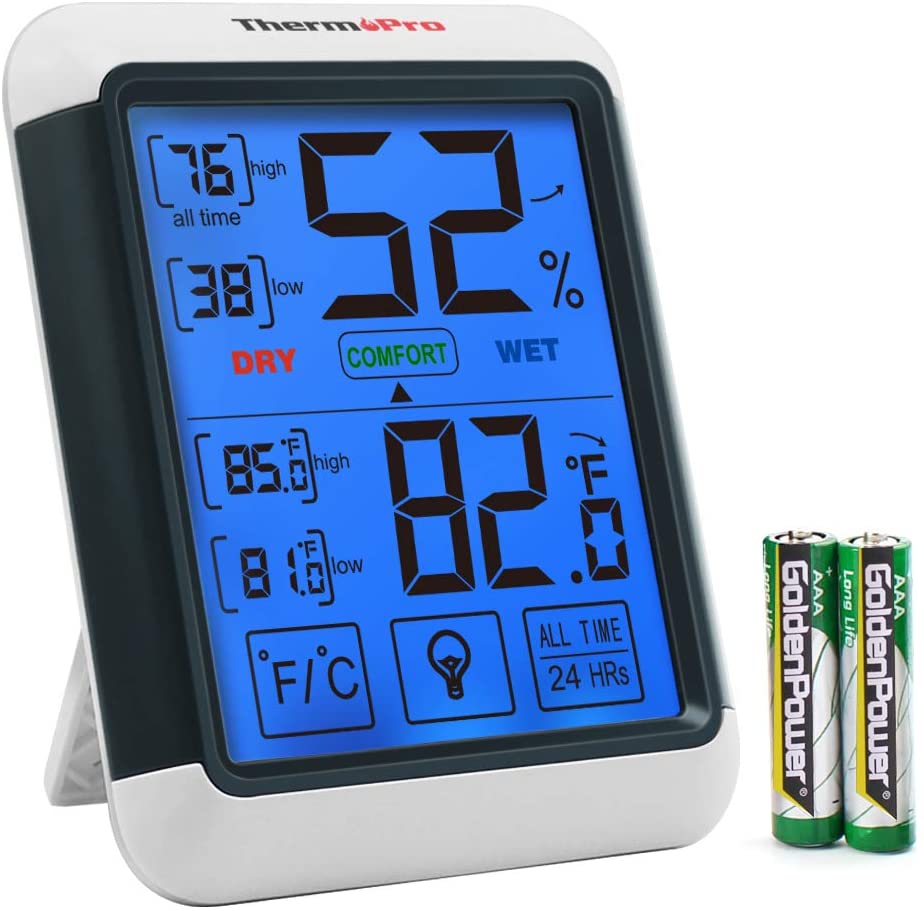
At number 3 on our list, we have the ThermoPro TP55 Digital Hygrometer Indoor Thermometer Humidity Gauge with Jumbo Touchscreen and Backlight Temperature Humidity Monitor. As you can tell by the name, this digital hygrometer has a touchscreen, making it very user-friendly.
What We Like
With advancements in technology, it seems every year something else upgrades to touchscreen capabilities. This is the biggest claim to fame of the ThermoPro, making it one of the best hygrometers on the market for tech-savvy individuals.
This hygrometer also is much bigger than typical hygrometer displays. It features a 4-inch LCD display while most hygrometer displays average 1.7 inches from corner to corner. This makes it very easy to read, which is great if you have any trouble reading books or screens up close.
One unique feature of this hygrometer is the trend display so you can adjust your environment ahead of time.
You can place it practically anywhere, as it has a flat stand to place on the counter or table, a clip to attach to a vertical surface, and a magnet to easily place it on a metal surface like your fridge.
This hygrometer features a daily record report. You can quickly view the high and low humidity and temperature levels from the day. Plus, you can easily match your humidity levels against high, low, or ideal conditions, making it one of the best hygrometers available.
What We Don’t Like
The ThermoPro is an overall great hygrometer. There were only 2 downsides to the device. For one, the glue on the magnets can make them fall right off the device, making it unable to stay attached to your fridge. And two, the hygrometer doesn’t display time, which isn’t the biggest problem, but most modern hygrometers have that functionality.
✓ Pros
- Touchscreen
- Large 4 inch screen
- Backlight for dim lit areas
- Records temperature every 10 seconds
- Trend display
- Multiple mounting options
- Comes with 2 x AAA batteries
✗ Cons
- Weak glue on magnets can make them come off
- Doesn’t display the time
#4 | Temp Stick Wireless Remote Sensor
Fourth on our list is the Temp Stick Wireless Remote Temperature & Humidity Sensor. If you’re needing a sophisticated, smart hygrometer for commercial use, or simply need to ensure you have a top-of-the-line hygrometer at home, then this is it. This hygrometer is by no means cheap, but it sure does have a few bells and whistles.
What We Like
This hygrometer is very futuristic. It’s a remote, wifi-connected temperature and humidity monitor. While most hygrometers can only be read from the device, you can read your data from anywhere right from your smartphone.
The Temp Stick comes with a free downloadable app for your smartphone that lets you view the temperature and humidity levels at any time.
Plus, the device comes with a 1-year battery life, so you don’t have to keep switching out batteries every few months. It also comes with a 3-year warranty, which is a nice bonus.
Beyond the ability to read data at any time from your phone, the most sophisticated feature is the ability to view historical humidity and temperature data charts right from your phone. It also can send text or email alerts if the humidity or temperature gets too high or low. You’ll also get alerts with low battery or wifi connection loss.
What We Don’t Like
It’s expensive. Compared to the average hygrometer, it’s about 10 times the price. If you desperately need to ensure your humidity levels are accurate and want to be able to read them at any time from your smartphone, then it may be worth the money.
Another downside to consider is that it isn’t compatible with enterprise wifi, which could be challenging if your workplace runs on that type of wifi.
✓ Pros
- Remote readings from your smartphone
- Smart hygrometer & thermometer
- Connects to wifi
- 1 year battery life
- High or low humidity alerts
- Connects to your tablet or PC
✗ Cons
- Very expensive. About 10 times the average hygrometer price
- Not compatible with enterprise wifi
#5 | AcuRite Monitor
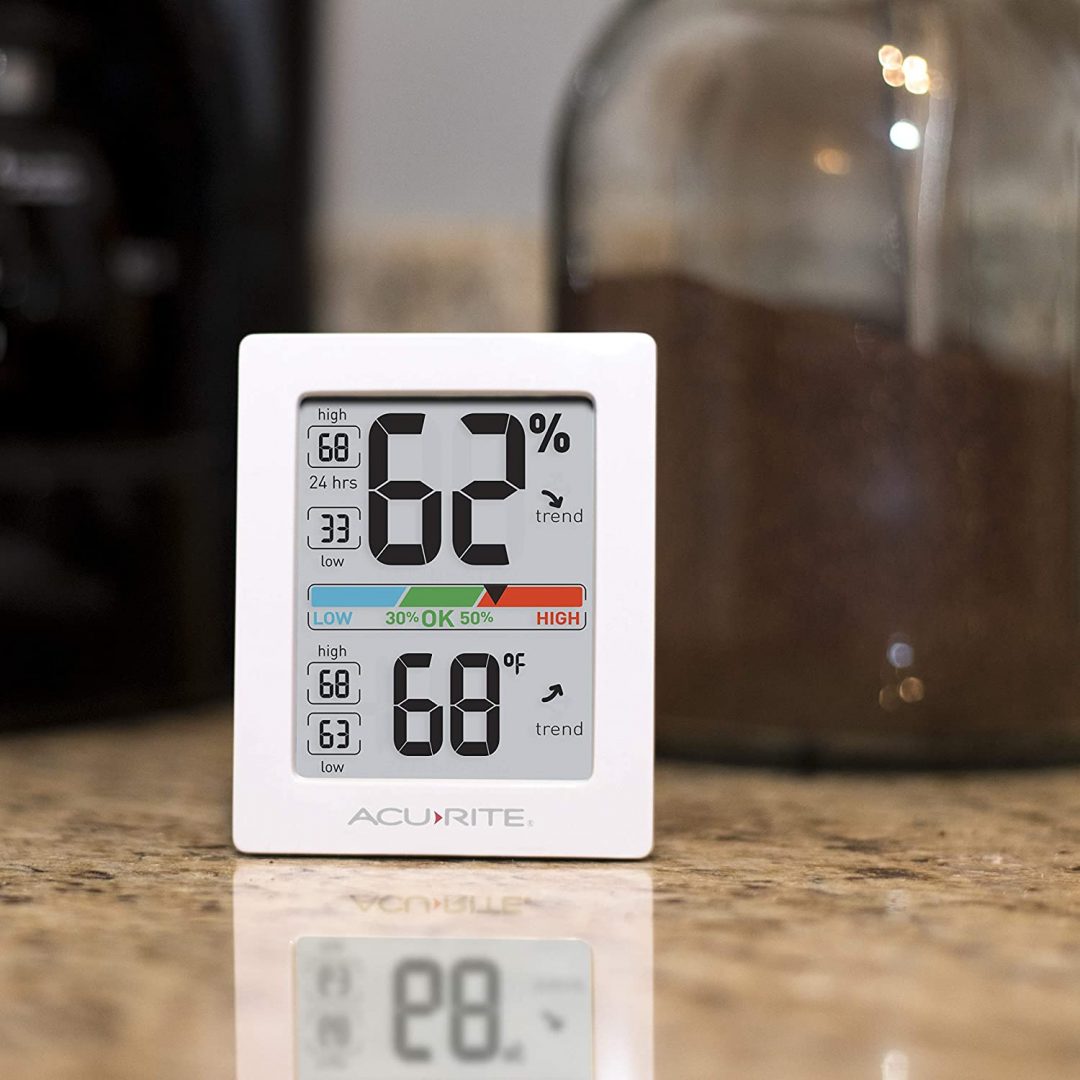
Next up on our list is another model from AcuRite. The AcuRite Monitor for Greenhouse, Home or Office is another impressive hygrometer available on the market today. It’s very similar to the AcuRite model at number one, but with a few upgrades.
What We Like
One of the upgrades this AcuRite hygrometer has on the first model is the humidity level indicator. While the earlier model has a humidity level indicator, this one is much more user-friendly. This indicator is color-coded, making it very easy to see when the humidity is in or out of the proper range.
Another advantage of this digital hygrometer is that it can be manually calibrated. This means you’ll be able to increase the accuracy of the hygrometer even better than the model at number one.
What We Don’t Like
While this digital hygrometer is an upgrade on the AcuRite at number one, it has two drawbacks. For one, there isn’t a backlight which can be annoying, especially when you’re trying to fumble over to your hygrometer at night.
Another downside is that it doesn’t show the numbers to the tenth decimal. It only shows them as whole numbers. So if you are wanting a hygrometer that shows readings accurate to the decimal point, you’ll want to pick a different one.
✓ Pros
- ±2% RH stated (10–90%)
- Color-coded humidity level indicator
- Manual calibration
- Daily high and low readings
✗ Cons
- No backlight
- Shows numbers as a whole, not to a tenth decimal
#6 | ThermoPro TP63A
Next up on our list is the ThermoPro TP63A Waterproof Indoor Outdoor Thermometer Digital Wireless Hygrometer. If you’re wanting a hygrometer that offers a two-in-one solution for the inside and outside of your home, then this might be the best hygrometer for you.
What We Like
The ThermoPro hygrometer is technically two separate hygrometers. The indoor hygrometer is the main device that features the LCD display, while the outdoor device is simply a secondary reader without a display. You can view both the indoor and outdoor data on the indoor hygrometer simultaneously.
The outdoor hygrometer and thermometer is completely sealed and includes a rechargeable lithium battery.
You can also purchase additional outdoor sensors and sync up to 3 outdoor sensors at a time to the main indoor device.
What We Don’t Like
The main downside to this hygrometer is the fact that you have to keep recharging the outdoor sensor every now and then. Thankfully, it comes with a USB charger and can be easily charged right from your PC or laptop. It’s also a bit more expensive than typical hygrometers.
✓ Pros
- Indoor & outdoor hygrometer
- Sync up to 4 hygrometers at once (1 indoor, 3 outdoor)
- ±2% RH stated (30–80%)
✗ Cons
- You have to keep recharging the outdoor sensor
- A bit more expensive than others
#7 | ThermoPro TP50 Digital Hygrometer
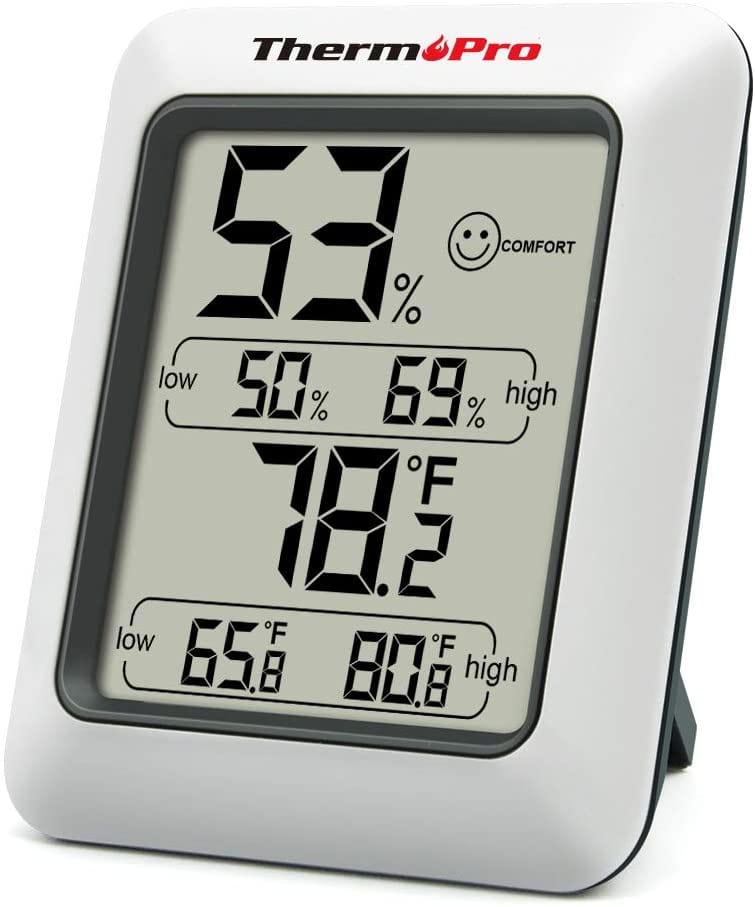
Next up we have another ThermoPro model to sit alongside the TP63A above. The ThermoPro TP50 Digital Hygrometer Indoor Room Thermometer and Humidity Gauge is the “lite” version of the ThermoPro indoor and outdoor combo. While this hygrometer is considered quite basic, it definitely gets the job done.
What We Like
This hygrometer offers an easy humidity indicator so you can quickly tell if humidity levels are in the right or wrong place. The display will show either “DRY”, “COMFORT”, or “WET” to give you a quick glance of your humidity.
This hygrometer has a great design. One advantage is that the magnet on the back is very durable. It’s attached right to the device rather than the foldable stand, and can easily be placed on your fridge.
What We Don’t Like
This hygrometer isn’t suitable for environments that have high humidity, like tortoise enclosures. If your pets need a high humidity environment, you’re better off picking a different hygrometer.
✓ Pros
- Budget-friendly
- Great magnet on the back
- Quick glance humidity indicator
- Daily high and low records
- 3-year warranty if registered
✗ Cons
- Isn’t best for high humidity environments
#8 | Govee Thermometer Hygrometer
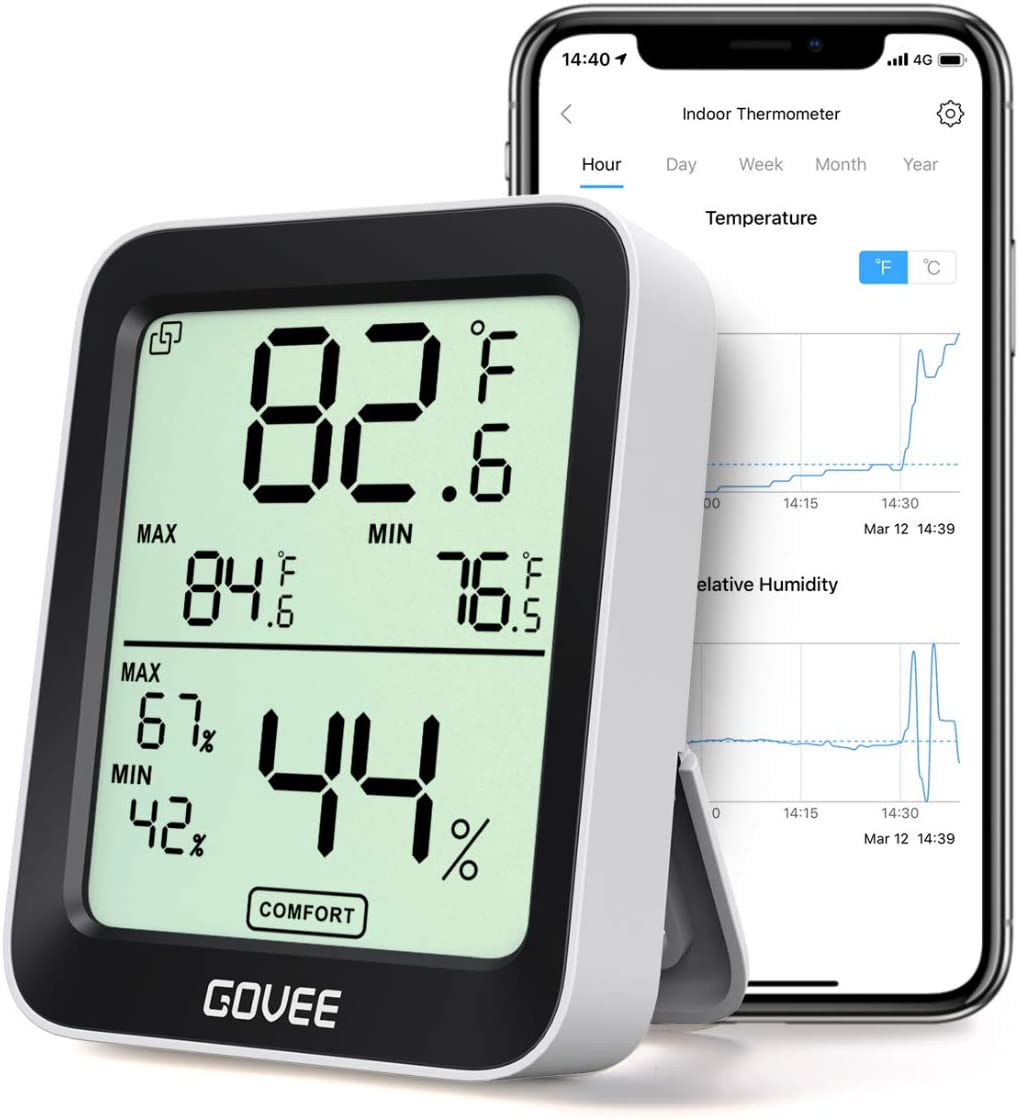
If you’re wanting a high-end “smart” hygrometer, but aren’t willing to fork out a ton of cash, then you’ll want to check this hygrometer out. The Govee Thermometer Hygrometer, Accurate Indoor Temperature Humidity Sensor is one of the best budget-friendly smart hygrometers available.
What We Like
Considering the price of this hygrometer, it’s a steal for what it offers. While most low-budget hygrometers are only readable from the device, you can view your hygrometer data right from your smartphone and from the device.
You can also view recent humidity and temperature records on your phone to look at how the data changes over time.
What We Don’t Like
While it’s convenient that you can view all data from your phone or from the LCD display on the hygrometer, one downside is that you can only view data through Bluetooth. This means you have to be at your home to look at data on your phone. It doesn’t connect to wifi so you can’t look at your levels when you’re outside the home.
✓ Pros
- Affordable
- Smart hygrometer
- View data from smartphone
- View recent data records
- Smartphone notifications when humidity or temperature is outside the proper range
✗ Cons
- Smartphone data only accessible through Bluetooth, not wifi
#9 | Cigar Oasis Analog Hygrometer
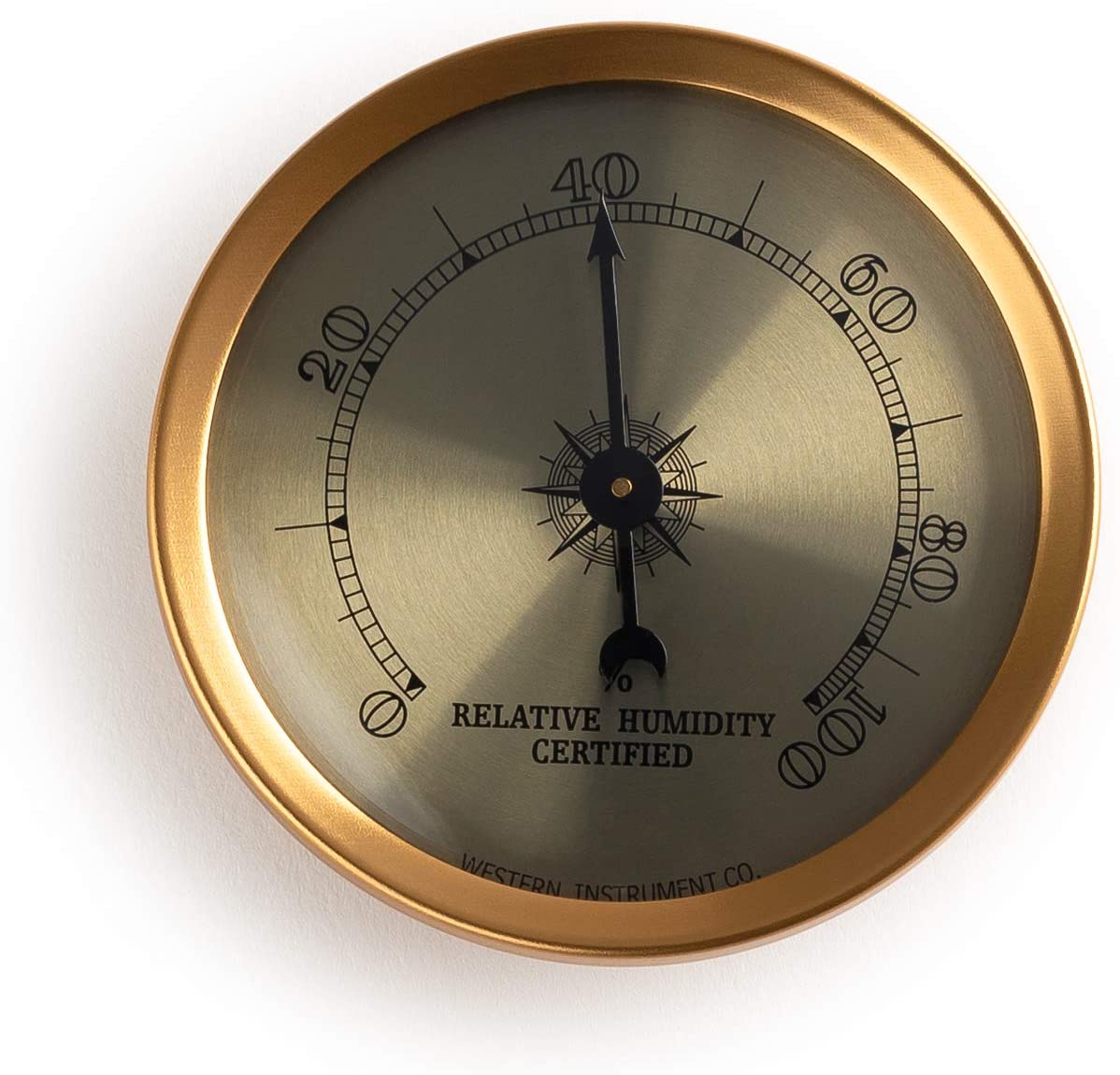
If you’re looking for something a little more “vintage”, then you’ll want to consider the Cigar Oasis Analog Hygrometer by Western Humidor. This is one of the best analog hygrometers on the market today. It’s a great mechanically-operated hygrometer that was specifically designed to preserve cigars.
What We Like
The Cigar Oasis Analog Hygrometer is sold with a stated accuracy of plus or minus 1 percent — an unusually tight claim for a mechanical dial, so confirm it with a salt test. You can also manually recalibrate the hygrometer whenever you like to match your standards.
The hygrometer also has a high-quality build. It has a corrosion-resistant aluminum case, a scratch and fog resistant glass face, and includes a secure magnetic mount.
What We Don’t Like
It’s not great at handling environments with high humidity. It’s really only meant to be used for cigars. It shouldn’t be used for enclosed animal environments. It also doesn’t come with instructions on how to calibrate it, which means you’ll have to manually calibrate it on your own.
✓ Pros
- Maker states ±1% RH
- Offers manual recalibration
- Corrosion-resistant aluminum case
- Scratch & fog resistant glass
- Secure magnetic mount
- Very affordable
✗ Cons
- Can’t handle high humidity
- No instruction manual
#10 | Cigar Oasis Caliber IV
If you’re wanting to keep your cigars in excellent condition, then this might be the best hygrometer for you. The Cigar Oasis Caliber IV Digital Hygrometer by Western Humidor is an impressive device that will help maintain the quality of your cigars for years.
What We Like
It works. The Cigar Oasis Caliber IV Digital Hygrometer is an impressive little device that will be sure to keep your cigars in good shape. It comes pre-calibrated right out of the box, and also lets you manually recalibrate when you want.
This cigar hygrometer includes three day high and low averages for both temperature and humidity to ensure you can keep a good watch on your cigars.
What We Don’t Like
It’s not pretty. It’s not vintage. The looks won’t impress your friends when you open up your cigar case. But, this device wasn’t made for the looks. It was made to work, and that’s something it does well.
It’s also not the cheapest hygrometer on the market. It’s not extremely expensive, but there are definitely cheaper options available.
✓ Pros
- Pre-calibrated out of the box
- Secure magnetic mount
- Includes battery
- 3 day high/low humidity and temperature averages
- Manual recalibration
✗ Cons
- Not “fancy-looking” for a cigar hygrometer
- A bit more expensive than other hygrometers
Best Hygrometer Buyer’s Guide
As mentioned earlier, a hygrometer is a device that measures humidity or the moisture level in the air at any given time.
Hygrometers can be used for a variety of reasons, though their function is specifically to measure the humidity. Something important you should consider about hygrometers is that they aren’t meant to adjust or regulate temperature or humidity levels. Their main purpose is to simply tell you what the current state is.
So what are hygrometers used for the most?
Cigar Humidors
One of the most popular uses for hygrometers is for cigar enthusiasts. In order to keep cigars fresh, you have to ensure they are stored properly. Cigar enthusiasts will buy a wooden box called a cigar humidor to store their cigars in. These wooden boxes are meant to maintain humidity levels despite external conditions.
Cigar humidors allow cigars to stay fresh and maintain a certain moisture level. This is crucial since tobacco leaves that contract or expand depending on the level of humidity in the air around them.
What Else Are Hygrometers Used For?
Hygrometers aren’t just used for cigar humidors. There are a variety of reasons people use them:
- Maintaining humidity in a specific room for medical reasons
- Minimizing humidity to prevent mold growth
- Ensuring an animal or pet’s environment is kept in stable condition (generally reptiles)
- Reducing risk of asthma-inducing agents including dust, fungi, and other viruses and bacteria
- Protecting expensive equipment including wines from being ruined by excess humidity
What Humidity Level Should You Aim For?
For most living spaces, aim for 30–50% relative humidity. This range is comfortable for people and low enough to discourage mould growth and dust mites, which become a problem when humidity sits above roughly 60% RH for extended periods. Below about 30% RH, dry air begins to cause static electricity, dry skin and irritated airways, and can crack wood and musical instruments.
Different environments need different targets:
| Environment | Typical target RH | Why |
|---|---|---|
| Living rooms and bedrooms | 30–50% | Comfort; limits mould and dust mites |
| Cigar humidors | 65–72% | Keeps wrappers supple without encouraging mould |
| Wine storage | 50–70% | Stops corks drying out and shrinking — full wine cellar guide |
| Acoustic instruments | 40–50% | Prevents wood cracking or swelling |
| Basements | Below 60% | Limits condensation, musty odours and mould |
Treat these as starting points rather than rules — the right figure depends on your climate, the season, and what you are protecting. For more on interpreting a reading in context, see how to measure humidity and what today’s humidity actually means.
How to Choose a Hygrometer: What Actually Matters
Ignore feature lists for a moment and compare devices on these criteria, roughly in order of importance:
- Stated accuracy. Look for a manufacturer-quoted tolerance, typically ±2–3% RH on a decent consumer digital hygrometer. A display showing tenths of a percent is not the same as being accurate to tenths of a percent, and what an accuracy claim actually covers is narrower than it looks — it describes a batch of sensors, at one temperature, when new.
- Calibration. Can the device be adjusted? Analog hygrometers usually have a screw on the back; some digital models have a reset function. If it cannot be calibrated at all, you can still note the offset and correct manually.
- Measurement range. Check the device covers the humidity and temperature range you actually need — a household monitor may not be rated for a greenhouse, a freezer or an unheated garage.
- Response time. Mechanical and hair-tension hygrometers react slowly. If you need to see the effect of ventilation or a dehumidifier quickly, choose electronic.
- Placement tolerance. Every reading is local. Direct sunlight, radiators, vents, exterior walls and doorways all distort results regardless of how good the sensor is.
- Display and logging. Min/max memory reveals overnight extremes a spot check would miss. Wireless and app-connected models add remote access, at the cost of batteries, setup and app dependency.
Digital & Analog Hygrometers
There are two types of hygrometers: analog and digital, compared side by side in our digital vs analog hygrometer guide. Analog hygrometers are the “traditional” hygrometer type that have been used for centuries to measure humidity. These are usually crafted with a metal frame, and include a face similar to a watch that includes arrows that point to certain numbers in a wheel to designate the metrics.
Oftentimes, cigar humidor containers will already feature a built-in analog hygrometer. However, although analog hygrometers may give off a “vintage” feeling, they are generally less accurate than digital hygrometers.
Though they offer a better appearance, analog hygrometers are also harder to calibrate.
Digital hygrometers offer a much more accurate picture of the humidity levels in your room or humidor. Nowadays, digital hygrometers also double as a thermometer, and may even give you daily averages, or historical data.
The most advanced hygrometers will even connect right to your smartphone through an app so you can read the data right from your mobile phone. For a full technical breakdown, see our digital vs analog hygrometer comparison.
Which hygrometer do I need for my home, basement or humidor?
Match the device to the job. For living spaces, where the 30 to 50% RH target band is wide, an inexpensive digital unit with a temperature reading and daily high and low records is enough; our pick is the AcuRite 00613. For a humidor, where the 65 to 72% band is narrow, buy one with adjustable calibration, such as the Cigar Oasis Caliber IV. For a basement or crawl space, use a remote sensor with the display upstairs, such as the ThermoPro TP63A. To check a place you are not in, you need a wifi sensor with alerts, such as the Temp Stick.
What is the most accurate type of hygrometer?
A chilled-mirror dew-point hygrometer. It cools a mirror until dew forms and measures that temperature directly, which is why laboratories use it as the reference for calibrating other instruments. For home use a digital hygrometer with a capacitive sensor is the practical choice: good consumer models are specified at ±2–3% RH, and a salt test shows how close your own unit is.
Which hygrometer brand is best?
No brand is best for every job, and published accuracy differs more between models than between brands. In this guide the tightest published specifications come from the SMARTRO SC42 and the AcuRite 01083M (both ±2% RH over most of the range). ThermoPro covers budget and indoor/outdoor models, Temp Stick and Govee cover wifi and Bluetooth monitoring, and Western Humidor’s Cigar Oasis line is built for humidors. Choose the model by use, then check the unit you receive.
Which hygrometer is best for the money?
The best value is the lowest total cost for the features and verified performance your use requires. Compare current prices, display, adjustment, history and connectivity; do not infer accuracy from price alone.
Are inexpensive hygrometers accurate?
They can be useful, but price alone does not establish accuracy. Check the exact model specification and, where needed, compare the instrument with a suitable reference near its intended operating humidity.
Is 70% humidity too high for a house?
Yes. The US EPA advises keeping indoor relative humidity below 60%, and ideally between 30% and 50%, because humidity sustained above about 60% encourages mould, condensation and dust mites. A steady indoor reading of 70% points to a moisture source or poor ventilation rather than a faulty hygrometer — though it is worth salt-testing the instrument before acting on the number.
How accurate are hygrometers?
Accuracy depends on the model, humidity, temperature and conditions. Read the specified error range rather than treating a display resolution or a single reference check as proof of performance everywhere.
How do you calibrate a hygrometer?
Compare the instrument with a suitable reference using the reference and instrument instructions. Record the conditions and deviation, adjust only as permitted, and recheck. A one-point salt check does not calibrate the entire measuring range.
How often should a hygrometer be calibrated?
Follow the manufacturer or calibration provider’s interval. Recheck when readings become inconsistent, after adverse exposure or when the consequences of error warrant it.
Where should you place a hygrometer?
Put it where air circulates freely, away from direct sunlight, radiators, air-conditioning vents, exterior walls, doorways, kitchens and bathrooms. After moving a hygrometer, give it time to equilibrate before trusting the reading. Large spaces often need more than one sensor.
What is the difference between a hygrometer and a psychrometer?
A psychrometer is a type of hygrometer. It uses two thermometers, one dry and one with a moistened wick, and derives relative humidity from the temperature difference caused by evaporative cooling. See our full explanation of psychrometers.
Do I need a thermometer as well as a hygrometer?
In practice, yes, and most hygrometers include one. A relative humidity reading cannot be interpreted without knowing the temperature. Combination devices are called thermohygrometers.
Can you make your own hygrometer?
Yes. A basic hair-tension hygrometer can be built at home using a strand of hair, a pointer and a scale, though it will not match a calibrated digital sensor for accuracy. We cover the method in how to make a hygrometer.
Sources
- Sensirion. Datasheet SHT4x — Humidity and Temperature Sensor — typical accuracy and long-term drift figures.
- National Institute of Standards and Technology. Humidity Calibration Services at NIST — calibration uncertainty for reference instruments.
- Greenspan, L. (1977). Humidity Fixed Points of Binary Saturated Aqueous Solutions, Journal of Research of the National Bureau of Standards 81A(1) — the 75% RH salt-test reference value.
- US Environmental Protection Agency. A Brief Guide to Mold, Moisture and Your Home — the 30–50% indoor humidity guidance.
We hope this guide helped you find the right hygrometer for your needs. Any suggestions or questions, let us know below!