
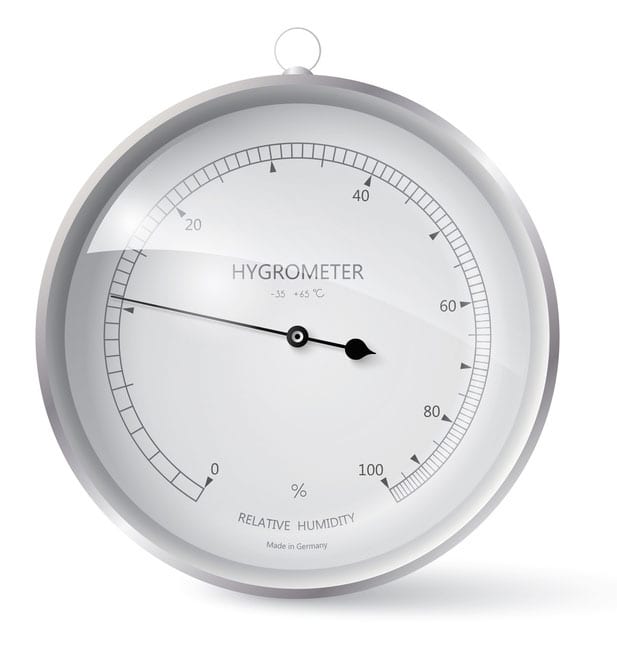

A hygrometer’s accuracy is not the number of decimal places on its display. Compare the specified error for the exact instrument at your expected humidity and temperature, then decide whether you need a reference check. A sensor datasheet, a product claim and a test of your own unit provide different evidence.
This guide explains the terms, shows how to compare claims and helps you choose between checking an existing instrument and buying another. For product options, start with the hygrometer chooser; for cigar storage, use the humidor selection checklist.
Accuracy, resolution and repeatability are different
| Term | Meaning | Buying implication |
|---|---|---|
| Accuracy specification | The stated closeness to a reference under defined conditions. | Read the range, temperature, exclusions and whether the value is typical or a limit. |
| Resolution | The smallest change displayed, such as 0.1 percentage point. | An extra decimal place does not prove lower error. |
| Repeatability | How consistently an instrument reads under the same conditions. | Stable readings can still have a systematic offset. |
| Response time | How quickly the instrument follows a change. | Allow stabilization before comparing readings. |
| Calibration and adjustment | Calibration compares with a reference; adjustment changes the instrument’s response. | A comparison may reveal an error even if the instrument cannot be adjusted. |
What does ±3% RH mean?
In humidity specifications, ±3% RH generally means three percentage points of relative humidity, subject to the manufacturer’s stated conditions. Around a reference of 50% RH, that corresponds to readings from 47% to 53% RH if the stated limit applies. It does not mean three percent of 50, and it is not automatically a statistical confidence interval.
Ask whether the number applies to the complete instrument or only its sensor component. Sensirion’s SHT4x datasheet, for example, distinguishes sensor variants and provides performance curves; it should not be used to assign the same accuracy to every finished monitor containing a related sensor.
Compare specifications before comparing prices
- Exact model: confirm the model and revision offered by the seller.
- Relevant range: check performance at the humidity and temperature you expect, not just the broad measuring range.
- Typical versus maximum: do not treat a typical value as a guaranteed limit for every unit.
- Conditions and age: read the restrictions, maintenance guidance and any drift information.
- Adjustment: confirm the supported method and range of correction before buying a reference kit.
Choose the required performance for your use
| Use | Prioritize | Continue |
|---|---|---|
| Home or basement | Readable temperature and humidity, useful history and sufficient accuracy near your action thresholds. | Home guide · Basement guide |
| Humidor | Performance near the storage range, suitable size and mounting, and a practical checking procedure. | Humidor purchase checklist |
| Remote monitoring | Suitable measurement performance plus reliable connectivity, alerts and power. | Compare monitoring options |
| Laboratory or controlled process | A defined uncertainty requirement and an appropriate calibration service. | NIST humidity calibration overview |
A broad acceptable humidity band does not make measurement error irrelevant. Near a decision threshold, an error of a few points can change what you conclude. Select the instrument around the decision you need to make.
How to check the hygrometer you already own
- Read both sets of instructions. Check the instrument manual and the instructions for the chosen reference or calibration kit.
- Control the setup. Use the required container and temperature conditions. Keep the instrument clear of liquid and allow the specified stabilization time.
- Record the evidence. Note the reference value, temperature, time, displayed humidity and the difference. Do not rely on memory.
- Adjust only as supported. Apply a correction using the model’s documented procedure, then repeat the comparison.
- Check whether the result answers your question. A measurement near the intended operating humidity is more useful than assuming the same correction applies everywhere.
A saturated-salt reference can support a check at a particular humidity. Published reference values depend on the salt and temperature; the uncertainty of a published value is not the uncertainty of a homemade setup. Leaks, preparation, temperature changes and incomplete stabilization can affect the result.
A one-point check has limits. Agreement at one reference point does not establish accuracy across the full range, prove long-term stability or create traceable calibration. For a critical measurement, choose an appropriate calibration service.
What if two hygrometers disagree?
First place them in comparable conditions with airflow around their sensors and allow them to stabilize. Check temperature readings and avoid heat sources or direct sun. If they still disagree, the comparison reveals a difference, not which one is right. Compare each with a suitable reference.
If an instrument gives inconsistent results, investigate the setup, power and condition before recording a permanent offset. If its performance cannot meet your need, use the buying checklist to select a replacement.
Frequently asked questions
How accurate are hygrometers?
Use the specification for the exact instrument and the humidity and temperature where you will use it. There is no single accuracy figure that applies to all hygrometers.
Does a 0.1% display mean 0.1% accuracy?
No. Display resolution describes the smallest displayed step. It does not establish how close the reading is to the reference value.
Can I check a hygrometer with salt?
A suitable saturated-salt reference or calibration kit can provide a check at a particular humidity and temperature. Follow its instructions and allow stabilization. A home salt setup does not establish laboratory traceability or accuracy across the whole range.
Why do two hygrometers disagree?
They may differ in error, temperature, placement or response time. Let them stabilize in comparable conditions. A disagreement does not show which instrument is correct without a suitable reference.
Does an adjustment make the whole range accurate?
No. An offset can correct the observed difference at a reference point, but other errors may remain. Recheck near the intended operating range and follow the manufacturer’s adjustment instructions.
What should I buy for a humidor?
Compare fit, stated performance near the intended storage range, adjustment and the need for history or alerts. Use the humidor buying guide and checking procedure linked above.
Sources and method
This is an explanation of measurement specifications and checking methods. It reports no new hands-on product tests or laboratory ranking of retail hygrometers.
- Sensirion SHT4x datasheet: sensor specifications and operating conditions.
- NIST humidity calibration services: reference measurement and calibration.
- Greenspan, Humidity Fixed Points of Binary Saturated Aqueous Solutions: published salt-reference values.

5 thoughts on “Hygrometer Accuracy: How Accurate Are They Really?”