

As an Amazon Associate we earn from qualifying purchases. We also earn a commission if you buy through our ALORAIR links, at no extra cost to you.
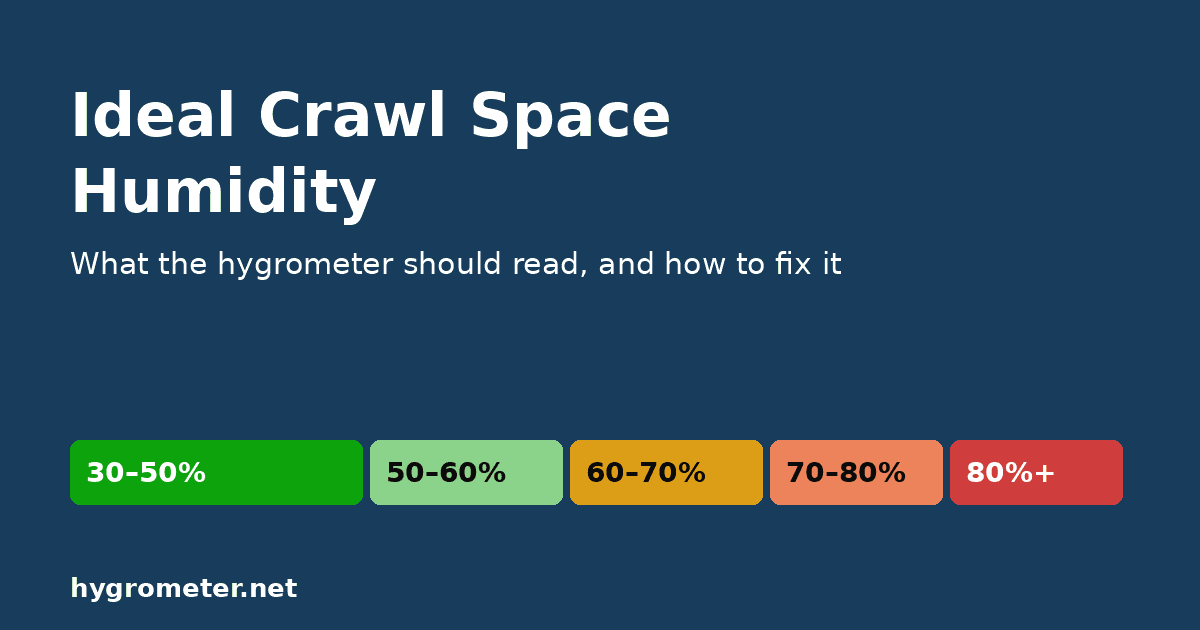
The ideal crawl space humidity is 30–50% relative humidity, and anything sustained above 60% needs fixing. In practice a sealed crawl space held at 50–55% is a safe, affordable target. Above 70% for weeks at a time, wood, insulation and ductwork start to get the conditions mold and rot need. A hygrometer in the crawl space is the only way to know which band you are in.
A crawl space is the part of the house nobody visits, which is exactly why its humidity matters. Moisture down there does not announce itself until the floor above smells musty, hardwood starts to cup, or an inspector finds damp joists. A crawl space hygrometer turns that guesswork into a number you can act on.
This guide covers what the reading should be, what each band means, why crawl spaces run so damp, where the sensor belongs, and how to bring the number down — including when a dedicated crawl space dehumidifier is the right fix.
What Should Crawl Space Humidity Be?
The EPA’s guidance for the whole house applies below the floor too: “Keep indoor humidity below 60 percent (ideally between 30 and 50 percent) relative humidity.” NC State Extension gives the same numbers and adds the practical trigger: “If over 60%, you should consider using a dehumidifier.”
The US Department of Energy’s Building America guide to closing and conditioning crawl spaces is more specific. It recommends a permanent dehumidification system “to maintain the 30%–50% humidity levels within the space” and says the moisture content of the wood “must remain below 17%.”
Most crawl space owners end up holding 50–55%. That keeps the space comfortably under the 60% ceiling without paying to run a machine toward a lower number that protects the structure no better.
What Each Reading Means
| Hygrometer reading | What it means | What to do |
|---|---|---|
| Below 30% | Drier than needed | Nothing; raise the setpoint if a dehumidifier is running |
| 30–50% | Ideal range (EPA, NC State, DOE) | Keep monitoring through summer |
| 50–60% | Acceptable; typical target for a sealed crawl space | Watch the summer peaks with min/max memory |
| 60–70% | Too high; condensation likely on cold ducts, pipes and joists | Find the source; plan a vapor barrier or dehumidifier |
| 70–80% | Mold, decay and dust-mite conditions at surfaces | Act now: seal the ground and vents, dehumidify |
| Above 80% | Active moisture problem | Look for liquid water: leaks, standing water, open vents in summer |
The 70% line is not arbitrary. Building Science Corporation’s research report on relative humidity puts it plainly: “Elevated relative humidity at a surface – 70 percent or higher – can lead to problems with mold, corrosion, decay.” The Building America Solution Center’s crawl space checklist uses the same threshold: “Air relative humidity levels above 70% are bad.”
Why Crawl Spaces Run So Damp
Three moisture sources stack up under a house, and only one of them is visible.
- Bare soil. An earth floor evaporates water into the space every day of the year. The EPA’s first recommendation for crawl spaces is to “put a plastic cover over dirt in crawlspaces to prevent moisture from coming in from the ground.”
- Summer air through the vents. Warm, humid outdoor air enters a crawl space that the ground keeps cool. Its relative humidity climbs as it cools, and anything below its dew point — ducts, cold water pipes, the underside of the floor — starts to sweat. The DOE notes that in humid climates “the air from outside is often more moist than the air in the crawlspace, leading to structural, mold, and pest problems.”
- Leaks and drainage. Gutters, grading, plumbing and condensate lines. These show up as a reading that stays high whatever the weather.
That second point explains the most common surprise: opening the vents in July makes a crawl space wetter, not drier. A hygrometer inside and one outside, compared by dew point rather than relative humidity, shows it within a day. Our guide to how to measure humidity covers the dew point comparison.
Where to Put a Crawl Space Hygrometer
- In the middle of the space, off the ground. Hang or mount it on a pier or joist around mid-height, not lying on the vapor barrier.
- Away from the dehumidifier’s discharge. A sensor in the dry air stream reads the machine, not the crawl space.
- A second sensor in the worst corner. Crawl spaces are rarely one room. The far leg of an L-shaped space can sit at 70% while the sensor next to the dehumidifier reads 52%.
- Wireless, with alerts. Nobody crawls under the house to read a display. A remote sensor with min/max history and a phone alert is the one feature that matters here. The Temp Stick sends wifi alerts without a hub; a Govee Bluetooth thermo-hygrometer works if your phone reaches the crawl space access.
Check the sensor before you trust it. Crawl spaces are cold, and most hygrometers are specified around room temperature; a unit reading five points low will show a reassuring 58% in a space that is really at 63%. The overnight salt test (saturated salt holds about 75% RH, per NIST’s reference measurements) settles it: see how to calibrate a hygrometer and how accurate hygrometers really are.
Check Temp Stick Price on Amazon → Remote wifi sensor with humidity alerts
How to Lower Crawl Space Humidity
In the order that costs least and does most:
- Stop liquid water. Gutters, downspouts that discharge away from the foundation, grading that slopes away from the house, and any plumbing leak. Nothing else works while water is getting in.
- Cover the ground. NC State Extension recommends “6-8 mil. plastic, or vapor barrier covering the soil.” This is the single largest reduction in moisture load for most crawl spaces.
- Close and seal the vents if you are converting to a sealed (unvented) crawl space. Building America research found unvented, conditioned crawl spaces use 15–18% less energy for heating and cooling “while reducing humidity over 20%.” Check local code first; the IRC requires a drying mechanism in an unvented crawl space.
- Add a crawl space dehumidifier. Once the ground is covered and the vents are closed, a dehumidifier holds the space at your setpoint. It has to be a unit built for the job: household portables ice up at crawl space temperatures and stop when their bucket fills.
- Keep monitoring. The hygrometer is how you confirm each step worked, and how you catch a failed pump or a blocked drain before the joists do.
When the hygrometer stays above 60%: a dehumidifier built for crawl spaces
ALORAIR makes the Sentinel line specifically for crawl spaces and basements. The features that matter under a house are all there: operation down to about 34 °F, a gravity drain or built-in condensate pump so there is no bucket, and a 6-year limited warranty (first 2 years full coverage). Size it to the crawl space footprint:
| Crawl space (sealed) | Model | Drain |
|---|---|---|
| Up to 1,000 sq ft | Sentinel HD35P (35 pints/day AHAM) | Built-in pump |
| Up to 1,300 sq ft | Sentinel HD55S (55 pints/day AHAM) | Gravity |
| Up to 1,300 sq ft, no floor drain | Sentinel HDi65S (55 pints/day AHAM) | Built-in pump |
| Up to 2,600 sq ft | Sentinel HDi90 (90 pints/day AHAM) | Built-in pump |
Coverage as listed by ALORAIR for a sealed crawl space. ALORAIR’s own sizing guide says to step up one size if the space is vented, very damp or in a hot-humid climate.
See ALORAIR crawl space dehumidifiers → Sentinel series, built for crawl space temperatures
Set the dehumidifier to 50–55% and let the hygrometer, not the machine’s own display, tell you whether the far corners are getting there. The machine’s built-in humidistat measures the air at its own intake, which is the driest air in the space.
What is the ideal humidity for a crawl space?
30-50% relative humidity is ideal, and the EPA sets 60% as the ceiling. A sealed crawl space held at 50-55% is a realistic, affordable target that keeps it safely below the level where condensation and mold become likely.
Is 70% humidity in a crawl space bad?
Yes. Building Science Corporation notes that surfaces at 70% RH or higher can grow mold and start to decay, and the Building America Solution Center treats air above 70% as a problem. A crawl space that sits at 70% for weeks needs its moisture source found and fixed.
Where should I put a hygrometer in a crawl space?
Mid-height in the middle of the space, off the ground and away from the dehumidifier discharge, with a second sensor in the dampest corner. Use a wireless sensor with alerts, because nobody goes under the house to read a display.
Should crawl space vents be open or closed?
In warm, humid weather open vents let in moist outdoor air that condenses on the cooler surfaces under the house, so a vented crawl space often gets wetter in summer. Sealed crawl spaces with a ground cover and a drying mechanism stay drier, but check your local building code before closing vents.
What size dehumidifier does a crawl space need?
Size it to the crawl space footprint and step up one size if the space is vented, very damp or in a humid climate. As an example, ALORAIR lists its 55-pint (AHAM) Sentinel HD55S for up to 1,300 sq ft and its 90-pint HDi90 for up to 2,600 sq ft of sealed crawl space.
The Bottom Line
Aim for 30–50% and treat 60% as the line you do not stay above. Put a wireless hygrometer in the middle of the crawl space and a second one in the worst corner, calibrate it, and read it through a full summer. If the number stays above 60% after the ground is covered and the water is dealt with, a crawl space dehumidifier from ALORAIR sized to the footprint is the fix — and the hygrometer is how you prove it is working. For the basement next door, see our basement hygrometer guide.
References
- US Environmental Protection Agency. A Brief Guide to Mold, Moisture and Your Home.
- NC State Extension. Mold and Moisture Checklist.
- US Department of Energy, Building America. Unvented, Conditioned Crawlspaces.
- IBACOS for NREL / DOE Building America. Guide to Closing and Conditioning Ventilated Crawlspaces (PDF).
- Building America Solution Center (PNNL). Look for Crawlspace Moisture Issues.
- Building Science Corporation. RR-0203: Relative Humidity.
- Greenspan, L. (1977), NBS/NIST. Humidity Fixed Points of Binary Saturated Aqueous Solutions (PDF).
- ALORAIR. Crawl space dehumidifier sizing guide and product pages, checked 27 September 2026.

2 thoughts on “Ideal Crawl Space Humidity: What the Hygrometer Should Read”