

A guitar hygrometer belongs inside the case, not on the wall of the room. Target 45–55% RH, treat 40–60% as acceptable, and use a digital unit rather than an analog dial — the case is a small, slow-moving environment, and the numbers that matter are the ones the instrument is actually sitting in.
A guitar hygrometer is the cheapest insurance an acoustic instrument will ever get. A dry winter indoors can shrink a spruce top enough to lift frets, drop the action and eventually split the wood, and none of that announces itself until the damage is done. The instrument gives no warning; the air does, but only if something is measuring it.
This guide covers the humidity range a guitar should be held at, what too-dry and too-wet actually do to the wood, where a guitar hygrometer should sit, which type works in a closed case, how the numbers differ for violins and pianos, and how to check that the reading can be trusted at all.
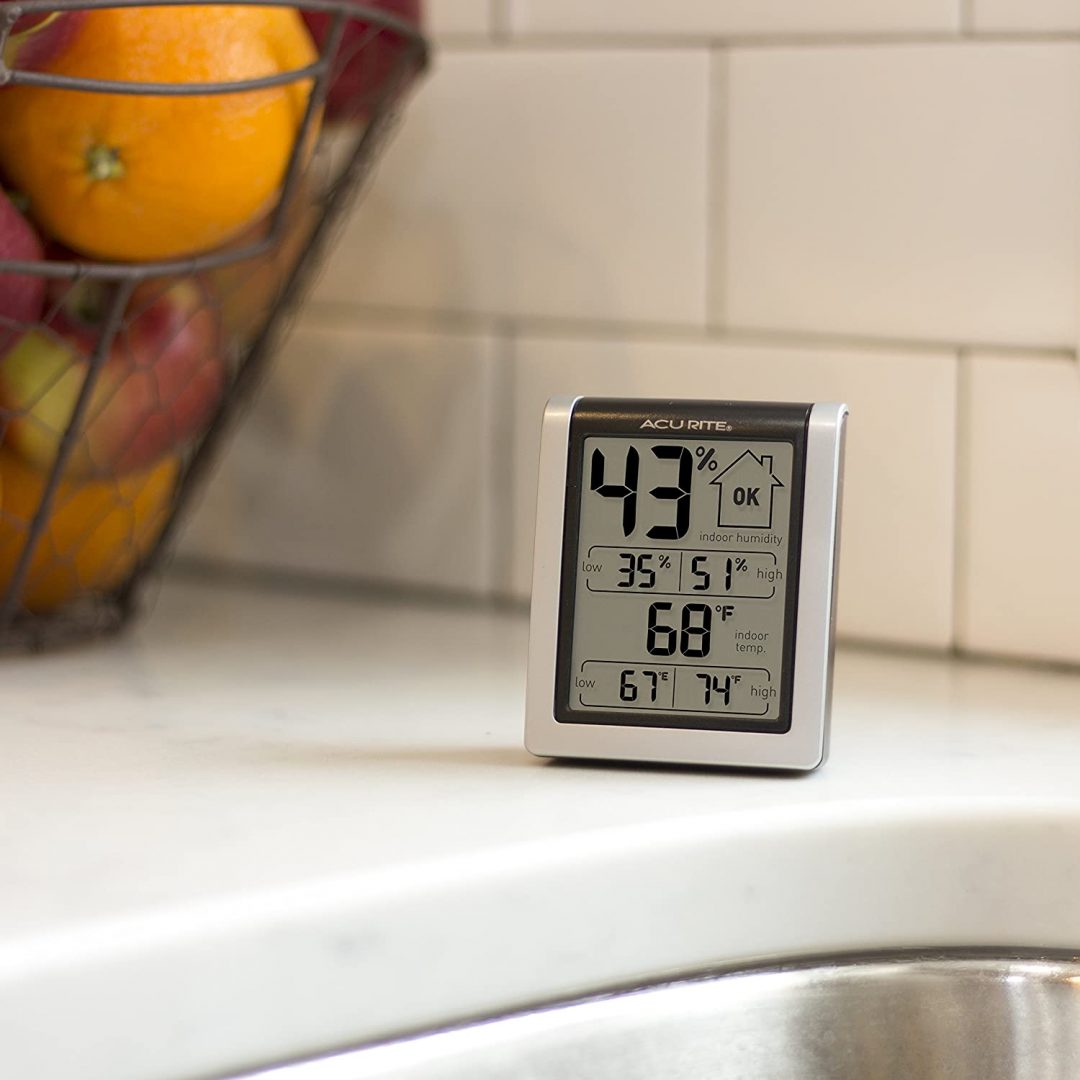
What Humidity Should a Guitar Be Kept At?
Taylor Guitars puts the target at 45–55% relative humidity, with 40–60% acceptable in practice. That band is not arbitrary. It is roughly the moisture content the wood was at when the instrument was built, braced and glued, and a guitar is happiest when it stays near the conditions it was assembled in.
The reason the range matters more than any single number is that wood is hygroscopic: it takes moisture from the air and gives it back, swelling and shrinking as it does. A solid top is a thin, wide, cross-grained panel glued to braces that run the other way. Move its moisture content far enough and something has to give — either the wood, the glue joint, or the geometry that sets the playing action.
A guitar hygrometer is what turns that from a theory into a number you can act on before anything gives.
What Goes Wrong at Each End of the Range
The two failure modes look nothing alike, which is useful — the symptoms tell you which direction you have drifted even before you read the display.
| Too dry (below ~40% RH) | Too humid (above ~60% RH) |
|---|---|
| Fret ends protrude and catch the hand | Action rises and the guitar plays harder |
| Action drops, strings buzz | Tone goes dull and lifeless |
| Top sinks slightly behind the bridge | Top and back swell, sometimes visibly |
| Finish checking, then cracks in the top or sides | Glue joints soften and can fail; finish lifts |
| Damage is often sudden and structural | Damage is gradual and often expensive to correct |
On the dry side, Taylor describes the early warning plainly: “If you notice your guitar’s action getting low and buzzy, or feel your frets protruding as you move up and down the neck, it’s likely a symptom of a dry guitar.” Fret sprout is the classic tell, because the fretboard shrinks across its width while the metal frets do not.
On the wet side the wood swells instead of splitting, which sounds gentler and often is not. Taylor’s guidance lists high action, a dull and lifeless sound, swelling at the tail block and a changed neck angle as the symptoms, and notes that the wood “can swell tremendously, causing glue joints to fail, finish to lift, and neck angles to go bad.” The exposure that does it is not a humid afternoon — it is roughly 60–70% RH held for months, or 80–90% for several weeks. Those are exactly the timescales a guitar hygrometer is good at catching and a person’s memory is not.
Acoustic, Laminate or Electric: Who Actually Needs to Watch This?
Not every instrument in the house needs its own sensor, and knowing which ones do saves money and worry.
Solid-wood acoustics are the priority. A solid spruce or cedar top is a single thin plate of wood free to move with the air, and acoustic guitar humidity problems almost always start there. If you own one good acoustic and are buying a single hygrometer for guitar case use, that is the case it goes in.
Laminate-topped guitars are far more tolerant. Plywood construction is cross-laminated, so the layers restrain each other and the panel moves much less. They are not immune — necks, bindings and fretboards still respond — but a laminate beginner guitar does not need the same vigilance as a solid-top instrument.
Electrics sit in the middle. A solid body barely moves, but the fretboard and neck do, and fret sprout on a dry electric is common. A shared room reading is usually enough here rather than a dedicated guitar hygrometer per case.
The practical rule: one sensor per case for solid-wood acoustics and any instrument you would be upset to lose, and a single room unit for everything else.
Case or Room: Where a Guitar Hygrometer Belongs
A guitar hygrometer sitting on the music room wall tells you about the room. The instrument does not live in the room; it lives in a case, and a closed case is a much more stable, much smaller environment — Taylor’s own comparison is that it works “like a humidor for a cigar.” That is the same logic behind putting a dedicated instrument in a controlled box rather than trying to condition the whole space, and it is why the reading that matters comes from inside.
Placement inside the case matters too. Taylor advises keeping the guitar hygrometer “in the open section of the case rather than inside the case compartment in order to accurately gauge the humidity level of the guitar” — the accessory compartment is a small sealed pocket with its own microclimate and it will not represent the air around the top. Practical placement rules for a guitar hygrometer:
- In the main cavity, near the instrument. Under the headstock or alongside the upper bout is fine; the accessory compartment is not.
- Away from the humidifier. A sensor sitting against a soundhole humidifier reads the humidifier, not the guitar. Keep as much distance as the case allows.
- Not pressed against the instrument or the lining. Contact with a surface biases the reading toward that surface rather than the surrounding air.
- Somewhere visible when you open the lid. A hygrometer you have to dig for is one you stop reading by February, which is the month you need it most.
- Consistently in the same spot. Comparability week to week is worth more than a theoretically perfect position.
Players who keep an instrument on a wall hanger or a stand are effectively choosing room humidification, and then a room hygrometer is the right instrument — but the whole room has to be held in the band, which is a much larger and more expensive problem than conditioning a case.
Digital or Analog for a Guitar Case?
For a guitar hygrometer that will live in a case, this one is not close. Taylor recommends a digital unit outright on the grounds that “a digital unit is far more accurate,” and the physics of the enclosure back that up.
| Factor | Analog dial | Digital (capacitive) |
|---|---|---|
| Typical uncalibrated error | Often 5–15 points | Often 2–7 points |
| Response time | Hours — smooths out the event you are trying to see | Minutes |
| Reads temperature too | Rarely | Usually |
| Fits a case | Bulky; hard to position well | Small, clip- or strap-mountable |
| Power | None needed | Battery — a silent failure point |
Response time is the deciding factor. Opening a case for ten minutes to change strings swaps the conditioned air for room air, and a slow dial averages that away into invisibility. A fast digital sensor shows the dip and the recovery, which is the information that tells you whether your humidification is actually keeping up. Our fuller digital vs analog hygrometer comparison covers the sensor technology behind the difference.
What to Look for in a Guitar Hygrometer
Once the type is settled, a handful of specifications actually change how useful a guitar hygrometer is in a case:
- Calibratability. The most important trait and the one least often printed on the box. A guitar hygrometer you can salt-test and correct beats one with a better accuracy claim you cannot verify.
- Size and mounting. Small units that clip to the strings, sit under the headstock, or strap into the case are far easier to position sensibly — and easy to lift out for testing.
- Temperature alongside humidity. Relative humidity is relative to temperature by definition. A guitar that goes from a cold car to a warm room sees its case RH move even though no moisture entered or left, and without a temperature reading that change is uninterpretable.
- Min/max memory. The damaging conditions usually happen while the case is shut and you are elsewhere. A unit that records the extremes catches what a spot check misses.
- Bluetooth, if the case stays closed. Genuinely useful here for a reason that does not apply to most rooms — you can read the case without opening it, and opening it is itself the disturbance.
- Battery life and a low-battery indicator. A dead sensor in a closed case fails silently, and you find out weeks later.
What matters less: very wide measuring ranges (a case occupies about twenty points of the scale), decimal resolution mistaken for accuracy, and “factory calibrated” claims, which describe an event before shipping rather than the condition of the unit in your hand.
Violins, Pianos and Other Wooden Instruments
The same reasoning extends across the wooden instrument family, with slightly different numbers.
Violins, violas and cellos sit comfortably in the same 40–60% band as guitars, and a violin hygrometer is usually the same class of small digital unit as a guitar hygrometer, placed in the case rather than in the room. The stakes are arguably higher: hide glue, used deliberately so that seams give way before the wood does, is itself moisture-sensitive, and open seams in a dry winter are a routine repair.
Pianos are the exception in one practical sense — you cannot put one in a case, so piano humidity is a room problem. Working figures from piano technicians cluster lower and tighter than for guitars, around 42% RH at 68 °F. More important than the exact target is stability: as one technician’s guidance puts it, “the more consistent one can keep the moisture level, the more consistent the tuning will stay and also the longer the piano will last.” Seasonal swings from 20–30% in a heated winter to near-saturation on rainy days are harder on an instrument than a steady figure slightly off the ideal.
If you are weighing up what to buy across several of these situations, our overview of hygrometer types and their uses covers the wider set of applications and which instrument suits each.
Calibrating a Guitar Hygrometer
Every guitar hygrometer drifts, and an accuracy figure on the packaging is a claim about a production run, not about the unit in front of you. The salt test converts that claim into a fact, costs nothing, and takes one overnight cycle.
Seal the guitar hygrometer in a bag or small container alongside a cap of damp table salt — salt wetted into a slush, not dissolved — and leave it for eight to twelve hours. A saturated salt solution holds the air above it at a precisely known humidity: Greenspan’s 1977 study for the U.S. National Bureau of Standards puts sodium chloride at 75.47% ± 0.14 at 20 °C, 75.29% ± 0.12 at 25 °C and 75.09% ± 0.11 at 30 °C. At normal room temperatures, 75% is the number to expect.
Whatever the unit reads is your offset. Some models let you correct it directly; on the rest you write “reads 4 low” on a piece of tape and add four for the rest of its life. Either is fine. What is not fine is a unit whose offset changes between tests — that one gets replaced. The full procedure, including the failure cases, is in our guide to how to calibrate a hygrometer.
It is worth testing on arrival and then roughly every six to twelve months. A guitar hygrometer that has been shut inside a case for a year in a warm house has had a harder life than the specification sheet assumed.
When to Check, and the Season That Matters
A guitar hygrometer earns its keep seasonally rather than daily. The dangerous period in most of the northern hemisphere is the heating season: warm indoor air holds far more moisture than it contains once it has been heated from cold outdoor air, and indoor RH in a heated house routinely falls into the twenties. That is well below the danger line, and it arrives gradually enough that nobody notices until the frets start catching.
A sensible rhythm:
- Weekly through the heating season, or whenever you open the case. This is when instruments crack.
- Monthly the rest of the year, as a sanity check on the setup rather than a search for problems.
- After any move — a new house, a different room, a car journey in winter, a gig in a dry venue.
- Recalibrate every six to twelve months, independent of how often you read it.
If the case sits reliably in the band all year, the guitar hygrometer has done its job by telling you to do nothing. That is the usual outcome and it is the point.
What is the best hygrometer to use in a guitar case?
A small digital thermo-hygrometer that you can calibrate, small enough to sit in the main cavity of the case without touching the instrument. Digital beats analog clearly here because a dial responds too slowly to show what happens when a case is opened and closed. Bluetooth models are a real convenience for case use, since they let you read the humidity without opening the case and disturbing it.
What is the best humidity for storing guitars?
45-55% relative humidity, with 40-60% generally acceptable. That range approximates the conditions the instrument was built and glued in. Consistency matters as much as the exact figure: a steady 45% is kinder to an instrument than a number that swings between 25% and 65% with the seasons.
Do you really need a guitar humidifier?
If a hygrometer shows the case sitting below about 40% RH for extended periods, yes. If the case holds 45-55% on its own year-round, a humidifier adds risk rather than protection, since over-humidifying causes swelling, high action and glue joint problems. The hygrometer is what tells you which situation you are in, which is why it comes first.
Where should I put a hygrometer in a guitar case?
In the main cavity next to the instrument, not in the accessory compartment, which is a small sealed pocket with its own microclimate. Keep it away from a soundhole humidifier so it reads the case rather than the humidifier, and keep it in the same spot each time so readings stay comparable.
Is 40% humidity too low for a guitar?
40% is the bottom of the generally accepted range rather than a danger zone, and a guitar held steadily at 40% is usually fine. The concern is drift: a case that reads 40% in mild weather often reads well under 30% once the heating runs, so 40% is a signal to start watching closely rather than a problem in itself.
The Bottom Line
Buy a small digital guitar hygrometer, salt-test it before you trust it, put it in the main cavity of the case away from the humidifier, and read it weekly through the heating season. Hold 45–55% RH, treat anything under 40% or over 60% as a signal to act, and pay more attention to how much the number moves than to where it sits inside the band.
That routine costs less than one fret dress and prevents the repair entirely. If you are curious how the sensor behind the display actually works, how hygrometers work covers the mechanisms, and the same measure-then-correct logic applied to a very different sealed box is in our guide to the best hygrometer for a humidor.
References
- Taylor Guitars. Using a Guitar Humidifier and Other Guitar Humidity Tips.
- Taylor Guitars. Symptoms of a Wet Guitar.
- Radford Piano Services. Humidity Basics.
- Greenspan, L. (1977). Humidity Fixed Points of Binary Saturated Aqueous Solutions. Journal of Research of the National Bureau of Standards — A. Physics and Chemistry, 81A(1).

3 thoughts on “Guitar Hygrometer: Ideal Humidity and How to Monitor Your Case”